
Category: time-restricted eating

  • Honor Your Body Clock, Create Circadian Alignment

    Honor Your Body Clock, Create Circadian Alignment

    Scientists have isolated the body-clock genes that control 24-hour light-dark circadian rhythm, and it’s now known that every cell in the body has a synchronized clock. 
     
    The 2017 Nobel Prize in Physiology and Medicine was awarded to three scientists who discovered the body clock gene and its critical role in metabolic function. In a world of 24/7 non-stop chaotic eating, relentless stress, continuous screen-gazing, sedentary lifestyle and sleep deprivation, time has become irrelevant. These constant 21st century disruptions of the powerful cellular body clock cycles (aka, circadian rhythm) are wreaking life-threatening havoc on mental and physical health, resulting in obesity, metabolic syndrome, cancer and diabetes.
     
    “We didn’t realize at the time that this clock would be represented all over the body in many different tissues and control so many different biological processes that we go through every day,” says Michael Young MD, 2017 Nobel Laureate in Medicine and Physiology. “It left us with the understanding that our whole bodies are rhythmically active.”  
     
    Circadian Alignment is when the central and peripheral clocks are aligned: bright light during daytime, sleep at night, and food intake during daytime. Circadian Misalignment is when the central and peripheral clocks are misaligned: light at night, sleep during daytime, and food intake at night.
     
    This misalignment has become normalized. According to a recent study of the eating habits of more than 34,000 U.S. adults, nearly 60 percent said it was normal for them to eat after 9 p.m. 
     
    Yet, time-restricted eating (12-16 hours of non-eating) has proven to be the best match to our circadian clocks. This means we need to eliminate nocturnal eating. We should stop eating by 6-7pm and not eat again for at least 12 hours (14 hours is the sweet spot).
     
    Our bodies have evolved to process nutrients during the day, and to conserve energy at night. The body uses energy to repair all of its systems at night, while we sleep. Disrupting that natural rhythm can cause problems.
     
    Several studies have found, for instance, that eating dinner within three hours of bedtime may worsen heartburn or acid reflux symptoms. And limited research has suggested that eating one to three hours before bedtime is associated with more disrupted sleep.
     
    The most intriguing research on late-night eating, however, has focused on its relationship with body weight and metabolic health.
     
    In one 2019 study of nearly 900 middle-aged and older U.S. adults, researchers at Brigham and Women’s Hospital in Boston found that those who consumed roughly 100 calories or more within two hours of bedtime were about 80 percent more likely to be overweight or to have obesity than those who did not eat during that window. Researchers have found similar results in adults in Sweden and Japan.
     
    And in a 2023 study of more than 850 adults in Britain, those who regularly snacked after 9 p.m. had higher levels of HbA1c, a marker for diabetes risk, and greater spikes in blood sugars and fats after daytime meals than those who did not typically consume late-night snacks.
     
    Research has also found that carbohydrates consumed in the evening result in greater blood sugar spikes than those consumed earlier in the day. That is in part because melatonin, a sleep-promoting hormone that increases in the evening, dampens the secretion of insulin, which regulates blood sugar levels. Elevated blood sugars could eventually damage blood vessels and increase the risk of developing high blood pressure and Type 2 diabetes.
     
    Research suggests that it’s best to avoid eating for three to four hours before your usual bedtime. We should be eating during an 8-12 hour window, allowing 12-16 hours for regeneration. We should also be sleeping for 7-8 hours each night. 
     
    A regular bed time is critical for your health and wellness, as is a regular waking time. Additionally, sleeping too long can affect your ability to fall asleep that night. After a good night’s sleep, most people need to be awake around 16 hours before they feel sleepy again.
     
    Going to sleep between 10:00 pm and 11:00 pm is associated with a lower risk of developing heart disease compared to earlier or later bedtimes, according to a recent study by the European Society of Cardiology. Early or late bedtimes may be more likely to disrupt the body’s circadian clock, with adverse consequences for cardiovascular health, according to the study’s authors.
     
    The incidence of cardiovascular disease was highest in those with sleep times at midnight or later (25% higher risk) and lowest in those with sleep onset from 10:00 to 10:59 pm. There was also a 24% higher risk for falling asleep before 10:00 pm. Yes, the body clock is that precise and sensitive. 
     
    Humans are not nocturnal animals; we are diurnal. We need to honor our innate body clock by eating and sleeping in a manner that naturally suits us and promotes health.
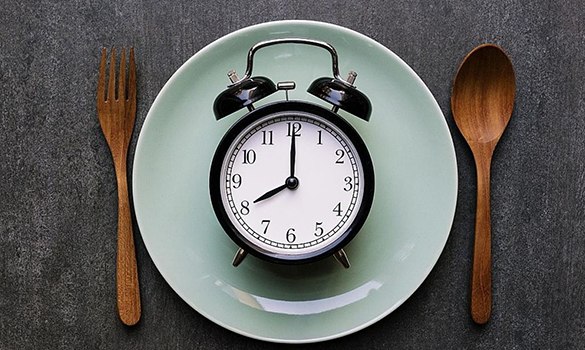
  • The Benefits of Intermittent Fasting

    The Benefits of Intermittent Fasting

    A lack of sleep may be a big contributor to America’s considerable weight problem.
     
    The National Sleep Foundation (NSF) recommends 7-9 hours of sleep each night for adults, ages 18-64. Yet, more than a third of American adults are not getting enough sleep on a regular basis, according to a CDC study.
     
    Sleeping less than seven hours per day is associated with an increased risk of developing chronic conditions such as obesity, diabetes, high blood pressure, heart disease, stroke and frequent mental distress, according to the CDC.
     
    The hunger hormones leptin and ghrelin have gotten a lot of attention in recent years. Though you may have heard of them, you may not be familiar with their functions.
     
    Think of the ‘l’ in leptin standing for lose. Leptin suppresses appetite and therefore contributes to weight loss. Think of the ‘g’ in ghrelin standing for gain. Ghrelin is a fast-acting hormone that increases hunger and leads to weight gain.
     
    When you’re sleep deprived, research shows, ghrelin levels surge while leptin plummets. The result is an increase in hunger.
     
    The key to reducing your nighttime cravings is to get more sleep; 7-9 hours.
     
    Another key to successful weight loss technique is intermittent fasting or time-restricted eating.
     
    Recent research shows the benefits of intermittent fasting, and those who have tried it often view it as a sustainable, long-term solution.
     
    In the simplest form, intermittent fasting would amount to 12 hours on and 12 hours off. For example, food can be eaten only between 7am and 7pm or 8am and 8pm.
     
    However, research shows that the sweet spot seems to be 10 hours on and 14 hours off. For example, eating only from 9am to 7pm, and then fasting until 9am the next day.
     
    Some intermittent-fasting proponents use only an eight-hour feeding window, with 16 hours of continual fasting each day. For example, eating meals between 12pm and 8pm each day, and fasting at all other times.
     
    This helps to thwart any late-night snacking habits.
     
    The benefit of time-restricted eating is that it allows you to naturally reduce your food intake without counting calories. That’s preferable to most people.
     
    Ultimately, intermittent fasting is about the “when” of eating, not the “what” or “how much.”
     
    Some researchers believe that the rise of later nighttime eating may have thrown off our evolutionary circadian rhythm, the 24-hour cycle that governs the physiological processes of humans and most other living beings, which may be contributing significantly to increases in obesity.
     
    Some studies suggest that by honoring the circadian rhythm and restricting feeding primarily to the daylight hours, we can improve our health and prevent disease.
     
    Fasting allows us to eat in harmony with our circadian rhythm. Circadian rhythms — which determine the sleeping and feeding patterns of all animals, including humans — can be modulated by external cues, such as sunlight.
     
    However, living in the 21st Century has disrupted our circadian rhythms. There is so much artificial light at night that the mind can confuse it with daytime. We also spend an exceptional amount of time (up to 12 hours a day) in front of screens (TVs, computers, tablets and smart phones) that emit blue light, which stimulates the retinal nerves and brain.
     
    21st Century adults spend, on average, 87%-93% of our 24-hours indoors and less than 5% of hours outdoors during the day. This light-dark rhythm disruption leads to less daytime alertness, and promotes depression (especially in older adults) and ADHD.
     
    This has resulted in circadian misalignment, in which our central and peripheral clocks are out of synch. Examples: too much light at night, sleep during daytime and food intake at night.
     
    Time-restricted feeding (12-16 hours of non-feeding) has proven to be the best match to our circadian clocks. The key is to eliminating nocturnal eating. The health benefits of time-restricted feeding double every extra hour of non-feeding time beyond 12 hours, up to 16 hours.
     
    While it is certainly wise to eat a variety of whole foods with high-quality sources of protein, fat and carbohydrate, timing may be the most crucial element when it comes to our eating habits.
     
    Another key is mindfulness. Being a more conscious (mindful) eater also helps you make healthier decisions during your eating window each day, so that you have adequate protein, fiber and water in your diet.
     
    In one study (by Dr. Satchidananda Panda, PhD), participants who adjusted their feeding time from their typical 14–15 hours down to 10 hours not only shed an average of 4% of their body weight, but also reported significantly improved energy levels and more satisfying sleep. Most remarkably, they ate their normal foods and didn’t change their exercise habits.
     
    Choosing to commit to intermittent fasting is easier if you do it with your partner/spouse or family. Any lifestyle change made in conjuncture with someone you live with can make a big difference. It creates a support system and can help keep you accountable.
     
    At the least, focus on getting 7-9 hours of sleep each night and eliminate nighttime snacking. However, you may want to try intermittent fasting / time-restricted eating for about a month to see how it works for you.
     
    It’s not very challenging. I do it and it’s made a difference for me. In fact, I highly recommend it.