If you’re a stress eater (i.e., you eat to cope with stress), restricting calories can cause even more stress.
If you eat a little less than your body needs, it can help you lose weight and body fat without sacrificing performance or wellbeing.
However, eating a lot less, especially for a long time, and especially when you have major recovery needs—like hard athletic training or recovering from surgery—can actually thwart proper recovery. It can even cause your body to turn down the thermostat, restricting calorie burning. In essence, your body goes into preservation mode.
Food is meant to nourish the body and the right amounts are vital to athletes. An excessive or chronic caloric deficit can impair performance, decrease lean muscle mass, and lead to a host of other issues ranging from hormonal imbalances to immune deficiencies.
You need to eat enough to support your physiological needs. Unfortunately, most Americans (truly, the majority) eat well beyond their physiological needs. Stress is a common culprit.
Cutting too many calories all at once can be very stressful and leave a person feeling like they’re starving. That’s not a formula for successful weight loss or athletic performance.
It’s best to taper slowly, gradually reducing your caloric intake. Say, for example, that you (or your coach or nutritionist) determine that you should be eating 2,000 calories per day (I chose this because it’s a round number that’s easy to work with). Let’s also say that you discover, through the use of a food app, that you’re actually eating about 2,600 calories per day, which is why you’re overweight.
You’re best off tapering to 2,400 calories for about two weeks, and then dropping down 2,200 for another two weeks before finally settling in at your proper intake of 2,000 calories per day. This gradual step-down will keep your body from going into starvation mode and keep you from feeling hungry all the time, which will undermine your efforts.
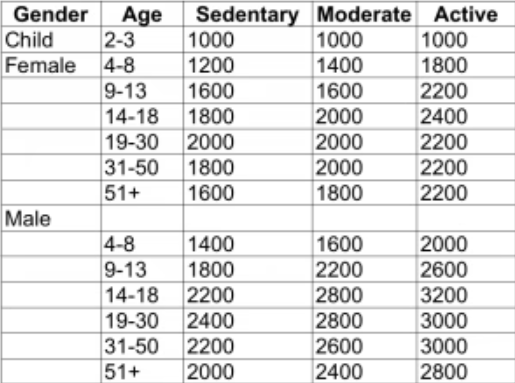
Calorie requirements are highly individualized. An ideal daily intake of calories varies depending on age, metabolism and levels of physical activity, among other things. The Dietary Guidelines for Americans provide calorie estimates for men and women based on age and activity level. For example, these guidelines note that the general recommended intake for adult women ranges from 1,600 to 2,400 calories daily, while men often require 2,000 to 3,000 calories a day to maintain healthy body weights.
Sedentary people need fewer calories because sitting is not very demanding, and most Americans are quite sedentary. According to a study reported by the American College of Sports Medicine, American adults, ages 20 to 75, reported spending an average of 9.5 hours sedentary each day, and most of this time was accumulated at work and during leisure-time. Then factor in that most of us sleep 7-8 hours per night.
Harvard Medical School says that sedentary adults require 13 calories for each pound of their body weight on a daily basis. For example, a sedentary 130-pound woman needs about 1,700 calories, while a 175-pound, inactive man requires about 2,300 calories daily to maintain a healthy body weight.
Yet, those numbers are to maintain body weight. If you need to lose weight, you’ll need to lower your caloric intake. The University of Washington suggests that overweight adults need 10 calories per pound of their desirable body weight to move toward that healthier weight. For example, an overweight woman with a goal weight of 130 pounds needs 1,300 calories daily, while an obese man trying to reach 175 pounds needs about 1,750 calories daily to reach his goal.
Again, any caloric reduction should be done slowly and gradually. Give your body — particularly your stomach and brain, which communicate hunger signals — time to adapt. Initially, at least, focus on eating slowly and eating more whole foods, instead of just eating smaller portions. After a week or two of these adjustments, you can begin to focus on portion sizes and limiting caloric intake, which should accelerate your weight loss. Being hungry all the time will cause a backlash and result in bad food choices and, ultimately, overeating.
Highly-processed foods, aka “junk” foods, are typically loaded with sugar, fat, and sodium. Beyond that, they often harm the microbiome, the delicate balance of microorganisms in the gut, which contributes to various health problems. Highly-processed foods are also associated with increased systemic inflammation.
If you can gradually shift to to eating more whole, minimally-processed foods more often, you’ll be on the right track. Don’t do it all at once and don’t be militant about it. Slowly cut your calories to a number that suits your sex, age and activity level.
Don’t restrict food to the point that it causes anxiety or stress. That will prove to be unproductive and will undermine your goals. Simply put, don’t deprive yourself. By eating more slowly, and eating foods that are high in protein and fiber, which are more filling, you can become more attuned to hunger sensations and learn to stop before overeating.
Lastly find healthier ways to cope with stress that don’t involve eating, such as taking a walk, doing a crossword puzzle, talking to a close friend or loved one, or even meditating. Stress is part of life; don’t let it undermine you.
Be compassionate with yourself. Be on your own side and don’t be so judgmental. Good things — the fruits of your labor — take time to manifest. Keep moving forward and know that your sustained efforts will pay off. Be patient and remain focused.