Category: body fat
-

Big-Boned, Big Myth
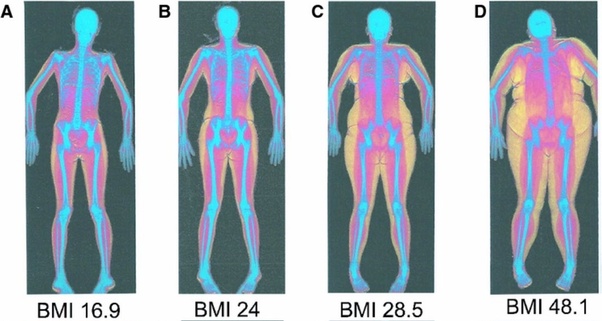
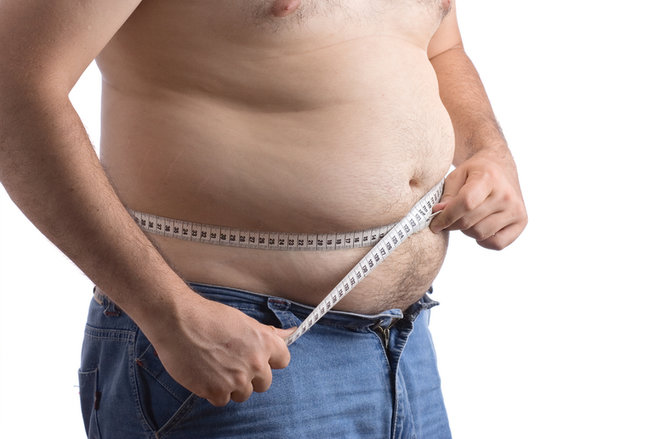
You may have heard the term “big-boned” used to describe some overweight or obese people. Sometimes it’s a self-description. How much do our bones really contribute to our weight?The average human skeleton will account for around 12%-15% of total body weight. So, a 200-pound man would have a skeletal weight of 24-30 pounds. A 150-pound woman has a skeletal weight of 18-22.5 pounds. Bone density refers to the concentration of minerals in your bones, yet dense bones may add only a few pounds to your frame. As an adult continually gains weight throughout life, it’s not because their bones become continually bigger and heavier.An adult’s skeleton weighs more than a child’s. And a 7-foot person’s skeleton weighs more than a 6-foot person’s, who’s skeleton weighs more than a 5-foot person’s skeleton. Beyond this, people are not “big-boned.” The bones in people of the same height are relatively the same weight. Most people who weigh too much for their height typically do so because of excess body fat, though a more-muscular body does indeed weigh more than a less-muscular body.Seventy-five percent of Americans are now either overweight or obese. Yet, most people aren’t body builders. Our national weight problem is a fat problem, unrelated to too much muscle or too much bone.The term “big-boned” is not a medical term. One orthopedic surgeon would tell her patients, “I have seen your bones, and they’re not big.” Being “big-boned” or “small-boned” doesn’t justify a 30-35 pounds differential from a normal-weight person of your height. If you are truly convinced that you are just big-boned and not overweight, buy a body-fat scale to measure your fat percentage. Excess weight is either the result of excess fat or excess muscle, not excess bone or big bones.So, the notion of being big-boned is a big myth… unless you’re Shaquille O’Neal, who is 7-feet, 2-inches tall.By the way, in 1992, at the start of O’Neal’s rookie season, he was listed at 325 pounds. According to Shaq, he weighed 395 pounds by 2002. But it wasn’t because his bones got bigger or heavier though. -

Diet vs Nutrition
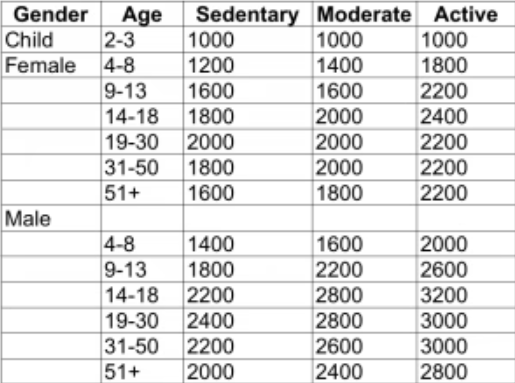
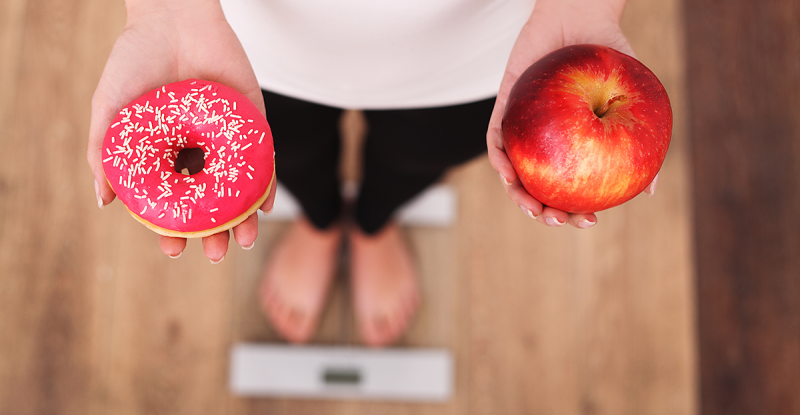
While many people continually “go on a diet” (and then another and another), everyone has a diet. I’ve never gone on a diet, but I’ve always had a diet. As I always say, diet should be viewed as a noun, not a verb. It’s a thing you have, not an action you take. Every action has a reaction (intended or otherwise), so any diet plan you initiate can quickly be halted in favor of something else.If you instead think of your diet as part of your lifestyle, you’re much more likely to stick to it.Everyone has a diet, but not everyone gets good nutrition. In the minds of many people, low-calorie means healthy. Yet, this isn’t necessarily true.For example, a rice cake has just 35 calories. Yet, it is almost entirely devoid of fiber and protein. Though a rice cake has very few calories, it also has very little nutrition, not to mention that it’s entirely processed.On the other hand, an avocado, which grows on a tree, is both calorically and nutritionally dense. An avocado can weigh anywhere from 8 ounces to 3 pounds (48 ounces). So, serving size matters.One cup (8oz) of sliced avocado has 234 calories and 21 grams of fat, most of which is monounsaturated. It is packed with fiber (10g) and potassium (more than a banana), and is also a great source of vitamin-C, folate and B-6. Additionally, it has virtually no sugar (despite being a fruit) and very few carbs (for those who care about such things).In short, an avocado is loaded with healthy fats, fiber and various important nutrients.Yet, some people would choose a nutritionally lacking rice cake over an avocado simply because it is lower in calories. Bad move. Caloric content and nutritional content are not necessarily related.No one thinks of a Big Mac as health food. Yet, you could eat three Big Macs a day and still lose weight. Don’t believe me? Well, a Big Mac has just 550 calories. Eat three a day and you’d ingest just 1,650 calories. Since the average American now eats a whopping 3,660 calories per day, eating one Big Mac for breakfast, lunch and dinner would cut that average intake by more than half. Do that, and watch the pounds melt away!However, you’d be missing lots of important nutrition on the Big Mac Diet. McDonald’s signature sandwich has minimal calcium, potassium and fiber, and zero vitamin D. However, it is loaded with sodium (44% of the daily value) and has 11 grams of saturated fat (53% of the daily value). Eat three a day and you’d be ingesting an enormous amount of salt and unhealthy fat.Oh, and one Big Mac also has nine grams of sugar. Eat three of them and you’d intake 27 grams of sugar, which is above the 24-gram daily limit recommended for women by the American Heart Association.Yet, on this Big Mac Diet you’d lose weight, and that would ultimately have a positive effect on your health. Scientific evidence shows that losing just 10 pounds can decrease hypertension, improve good cholesterol (HDL), lower triglycerides, decrease insulin resistance, reduce inflammation in blood vessels, improve or reverse sleep apnea, and increase energy and vitality.That said, there are better, healthier ways to lose weight than the Big Mac Diet.The point is that calories and nutrition are not synonymous. You can eat a low-calorie diet that is not healthy. More to the point, you can eat a low-calorie diet and not necessarily be healthy.On the other hand, you can eat a very healthy diet featuring high-calorie foods that are packed with nutrition (i.e., avocados, nuts, nut-butters, salmon, whole-fat yogurt, etc.). Additionally, high-calorie foods are more filling than most low-calorie foods (like rice cakes), meaning you might ultimately eat less.Low calorie foods are not necessarily nutritious, beneficial or preferable. And high-calorie foods are not necessarily unhealthy or to be avoided. The goal should be to maximize nutrition at each and every meal, even if you also seek to limit calories.If you need to lose weight to be more healthy, you can do this by eating healthy, whole foods, such as fruits, vegetables, a wide variety of animal- and/or plant-based proteins, plus whole grains (There’s more than just wheat, people! Try spelt, millet, amaranth, quinoa, black or red rice, whole oats, etc.).And, yes, you can indeed lose weight by including healthy, high-calorie foods in your diet. You just need to limit your total caloric intake. To do that, you need to track your daily caloric input. And you should also know how many calories you need each day.As the Twinkie Diet proved, you can eat an unhealthy diet and still lose weight. The Big Mac Diet would be no different.By the same token, you can have a healthy diet and still gain weight, if your caloric intake is higher than your needs.To lose weight, it comes down to quality and quantity. You should aim for higher quality foods, and a lower quantity of them, each day. -

The Bad and Good News About Fat Cells
The CDC reported in 2016 that obesity affected about 93.3 million US adults, or 40 percent of the adult population, and trend is worsening. The Harvard School of Public Health projects the obesity rate will rise to around 50 percent by 2030. In all, 72 precent (yes, nearly three-quarters) of the adult population is either overweight or obese. This has made weight loss a very big business.
The number of active dieters in the US is estimated at 97 million, and the total US weight loss industry hit a new peak of $72 billion in 2018, according to MarketResearch.com. Clearly, the desire for weight loss is widespread.
But those aren’t the only expenses. The CDC estimated the cost of obesity at $147 billion In 2008. A decade later, it’s surely higher.
With obesity reaching epidemic proportions, many have surely wondered if the problem is hereditary. Could obesity be passed down from parent to child? The CDC has answered that question: “Genetic changes in human populations occur too slowly to be responsible for the obesity epidemic.”
However, overweight and obese parents may pass on to their children the habits of physical inactivity and the tendency to eat high-calorie, processed foods. Conversely, active, healthy eaters may also pass on these same positive tendencies to their children.
Scientists are still learning about fat and not all of it is bad. At its core, body fat (aka, adipose tissue), is comprised of cells, just like everything else in your body.
It was once believed that adults could not create new fat cells. However, researchers have shown that adults constantly produce new fat cells, regardless of their body-weight status, sex or age.
Though the number of fat cells in a person’s body increases through childhood and adolescence, it remains fairly constant throughout your adult life, regardless of whether or not you diet or are thin or fat, say researchers at the Karolinska Institute, Sweden.
However, the scientists found that we continually create new fat cells (aka, adipocytes) to replace those that break down and die. Yes, when fat cells die, as all cells do, the body simply creates new ones in its effort to keep the number constant. About 10 percent of adipocytes die each year and they are replaced at the same rate.
The scientists at the Karolinska Institute found that obese people produce approximately twice as many new fat cells annually as lean people. They also found that fat cell death in obese people happens at twice the rate as lean people.
Other studies have shown that obese and overweight individuals have a greater number of fat cells than “naturally thin” people. When we slim down, fat cells shrink in size, but the total number of fat cells does not decrease. So, an obese person who loses weight will still have more fat cells than the person who never gained weight. The greater number of fat cells in formerly obese people may be a factor in their tendency to regain the weight they lost.
When we gain weight, we store the extra lipids we don’t use in our fat cells, which makes them grow in size. As we lose weight, these cells shrink, but they never disappear. Weight loss is attributed to fat cells shrinking, not losing them entirely.
Though excess body fat increases the risk of developing heart disease, type 2 diabetes, hypertension, stroke, osteoarthritis and certain cancers, not all body fat is the same.
Brown fat helps to maintain your body temperature and is activated when you get cold. While white fat stores calories, brown fat contains many more mitochondria (cellular engines), which burn calories to produce heat. In fact, brown fat even burns calories from white fat. The mitochondria in brown fat provide its color. Though brown and white fat cells are often mixed in together in fat tissue, white fat is much more prevalent.
Researchers have found that people with lower body mass indexes (BMIs) tend to have more brown fat. There is also evidence that brown fat activity declines with age, which may cause people to gain weight as they grow older, aside from the natural decline in muscle mass that lowers metabolic rate.
Additionally, researchers believe that exercise may stimulate hormones that activate brown fat, and that spending time in the cold may also cause the growth of new brown-fat cells.
It is believed that brown fat is activated and proliferates in response to overfeeding (aka, consuming too many calories). Since it takes energy to digest food, calorie burning usually increases at mealtimes. However, studies in humans have shown dramatic differences between individuals in the energy cost of overfeeding. These studies have shown that individuals with similar dietary intake and exercise patterns exhibit dramatic differences in their tendency to gain weight.
Researchers are looking into whether increasing the amount of brown fat could be a safe and effective therapy to limit obesity.
Though body fat is often viewed as our enemy, it has many useful purposes, such as: storing energy, storing fat-soluble vitamins (A, E, D and K), keeping us warm (fat is an insulator), and providing padding around our organs that protects us from physical trauma.
Clearly, some body-fat is necessary, even vital. The problem is that too many Americans have too much of it — sometimes far too much — to be healthy.
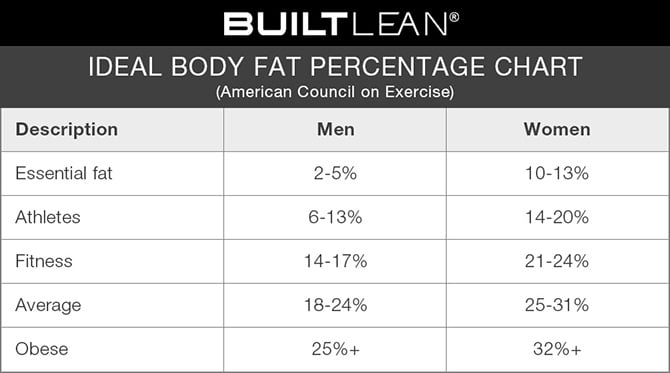
To determine healthy body-fat percentage ranges, based on your fitness level, follow these guidelines:

Eat well. Get in Motion. Stay in Motion.