Category: cardio
-

What Is Your Heart Rate Monitor Really Telling You?
Wrist-based heart-rate monitors are all the rage the days; many of my clients wear them to the gym each day. Yet, aside from the fact that these wrist-based heart-rate monitors are less accurate than the chest-strap versions, especially as you work harder (some models can be off by several beats per minute according to new research), they don’t offer users any perspective.What does it truly mean if your heart rate is 135, 145 or 155 beats per minute? Unless you know your maximum heart rate (MHR) and what percentage of it you’re working at, that info is useless.The well-known calculation of 220 minus your age to calculate MHR has long been known to be quite inaccurate. Yet, unfortunately, it remains a common standard for maximum heart rate calculations. For example, a 40-year-old person would subtract 40 from 220, indicating a maximum heart rate of 180 beats per minute.Known as the Fox formula, this classic maximum heart rate calculation was developed for untrained healthy adult males, though it was also considered valid for untrained healthy adult females and children.The Fox formula originated in the late 1960s, when William Haskell, an exercise physiologist who is now at Stanford University, and Sam Fox, a cardiologist, came up with a formula to determine the maximum heart rates of people who were having treadmill stress tests for heart disease.However, it was not really a scientific effort. Rather, it was a suggestion, based on a decidedly non-random and small sample of people. When Haskell and Fox proposed the formula, they never intended to give an absolute number for athletes or people who are used to exercising vigorously.Yet, it’s now recognized that that an individual’s maximum heart rate can vary widely from what that formula predicts — by as many as 30 beats per minute higher or lower.In essence, the Fox formula is as likely to be wrong as it is to be right. In fact, this formula’s reliability is 0.51. In other words, it’s reliable about half the time.The Tanaka formula for maximum heart rate is more accurate. It was developed based on studies of thousands of test subjects, can be used for all age and gender groups, and is considered to be more reliable than the Fox formula.• Fox: Maximum Heart Rate (beats/minute) = 220 minus Age• Tanaka: Maximum Heart Rate (beats/minute) = 208 minus (0.7 x Age)Using the Tanaka formula, a 40-year-old person would multiply 40 by 0.7, which equals 28. Then they would subtract 28 from 208, indicting a maximum heart rate of 180 beats per minute. You may remember that this is the same figure determined by the Fox formula. However, this is a coincidence, not the norm.For example:50-year-old• Fox formula: maximum heart rate = 170 (220 minus 50)• Tanaka formula: maximum heart rate = 173 (208 minus 35)30-year-old• Fox formula: maximum heart rate = 190 (220 minus 30)• Tanaka formula: maximum heart rate = 187 (208 minus 21)Ok, so now you can calculate your maximum heart rate. What does that mean? How does that help you?Reaching your MHR doesn’t mean your heart will explode! And it doesn’t guarantee a heart attack either. People train at this level for brief periods during their workouts every day, and they do it again and again and again.Most well-trained, fit people can maintain their maximum heart rate for just 1-2 minutes. Yet, world-class athletes may sustain their MHR for 3-4 minutes. On the other hand, a person who is quite out of shape may only be able to sustain their maximum heart rate for about 10 seconds or so.Yet, the ability to sustain MHR is just one measure of your fitness. How quickly your heart is able to recover from high-intensity exercise, during periods of lower heart-rate work or rest, matters a lot. The ability to recover (lower) your heart rate quickly is also an important measure of fitness.Familiarity and experience with exercise matters. Someone who works out regularly may be very accustomed to briefly pushing their heart rate to 85, 90 or even 100 percent. Yet, someone who is sedentary may find that pushing their heart rate to 70 percent is excruciating and scary. It’s all about perspective.It’s important to recognize that you can’t improve or increase your maximum heart rate with exercise. MHR is determined by genetics and age; as we get older, our MHR declines. Furthermore, not every 30-year-old will have the exact same maximum heart rate, nor will all 40-year-olds or 50-year-olds, etc. The calculation is an approximation, not a scientific assurance.What’s important is not what your maximum heart rate is, but what heart rate you can sustain for an extended period. Someone with a MHR of 190 isn’t necessarily more fit than someone with a MHR of 180. Person A, with the 190 MHR, may only be able to sustain 70 percent of that. Meanwhile, Person B, with the 180 MHR, may be able to sustain 85 percent of that. Person B is more fit, which is what matters — not an age-determined MHR.It’s important to remember that your heart rate has variability when you’re exerting yourself, such as when you’re working out. Most exercisers can’t simply pin their heart rate at 70, 80 or 90 percent of MHR. That’s because heart rate fluctuates throughout exercise. Your heart rate may rise quickly at the onset of a workout, then level out at a lower number. As you continue to workout, it may, over time, begin to climb again. And the harder you work, the more your heart rate may continue to rise throughout the workout.This is why you should pick a target heart-rate zone for your workouts, so that it doesn’t go to low or too high.The target heart rate during moderate intensity activities is about 50-70% of maximum heart rate, while during vigorous physical activity it’s about 70-85% of maximum, according to the American Heart Association.Of course, you can push your heart rate higher for brief periods and then allow it to recover. This is the essence of high-intensity interval training (HIIT), which is used not only by athletes but also by older folks and those with chronic conditions, such as diabetes or heart disease.Lastly, another important determinant of fitness is resting heart rate. The average resting heart rate is usually between 60 and 80 beats per minute, though it can even be as high as 100 bpm. Yet, some athletes have resting heart rates as low as 30 to 40 bpm. So, exercise can indeed lower resting heart rate, and this is important because every heart has a pre-determined number of beats from birth. The slower we get there, the better!In 2013, a team of Danish researchers published16 years of work on just under 5,200 men in the journal BMJ Heart. The researchers determined that higher resting heart rates correlated with a greater chance of dying.Those participants who ranged between 71 to 80 beats per minute had a 51 percent greater chance of dying prematurely than those with a resting rate of under 50 beats. At 81 to 90 beats per minute, that risk was double. And over 90, it tripled.So, there’s a lot more to the heart-rate story than just the number flashing on your watch.In conclusion, if you’re using a heart rate monitor while working out, it’s important to calculate your maximum heart rate, and to know your target heart-rate zone, as well as your resting heart rate. Once you know all of these things, then you’ll have some context for that heart rate number popping up on your watch. -
Don’t Be Fooled by Calorie Counters
How accurate are the calorie counters on the cardio machines (treadmills, ellipticals, bikes, rowers, etc.) that you use at the gym and at home?
Not very, it turns out. Numerous studies have shown that calorie counters on cardio machines are overstated.
For example, one University of California, San Francisco experiment conducted for Good Morning America, found that elliptical machines were the most optimistic, overestimating one exerciser’s calorie expenditures by 42 percent. Meanwhile, treadmills overestimated by 13 percent, stair climbers by 12 percent, and stationary bikes by seven percent.
Another issue to consider is the age of the equipment. Newer machines tend to be more accurate; older machines, less so.
Caloric expenditure varies based on gender, age, weight and fitness level — which includes aerobic capacity, metabolism and ratio of muscle to fat (more muscular bodies burn more fat).
Most cardio machines allow you to enter the first three variables — your gender, age and weight — so make sure to do it. That will give you a much more accurate portrayal of calories burned. We burn fewer calories as we age, and men generally burn more calories than women.
Many treadmills use a reference weight of about 155 pounds. If you don’t weigh 155 pounds, the reading at the end of your workout is not accurate. Enter your true weight. Heavier bodies burn more calories in any given workout.
Additionally, relying on the handrails—especially during higher inclines or while running at high speeds—can throw off your reading by as much as 40 percent. Avoid the handrails. When you walk outside, there aren’t any.
Your heart rate will also determine how many calories you burn, so make sure the machine can synch to your heart monitor, assuming you have one.
When it comes to burning calories, the greater your exertion, the greater the rate at which calories are burned. Working out at 60% to 75% of your maximum heart rate burns fewer calories than working out at 75% to 85% of your maximum heart rate.
As always, get in Motion; stay in Motion.
-

Walking Has Many Benefits, Even for Runners
While running is more physically demanding than walking, the latter is still a good form of exercise and a great recovery tool for runners. Running the same speed and distance each day can lead to plateauing. Walking, which is lower impact, can allow your body to recover and enable better results over the long term.Running will lead to greater cardiorespiratory fitness than walking, as well as more calories burned in an equal period of time. However, walking is a better alternative for people with ankle, knee or back injuries (including recent surgeries), as well as for people who are obese. Walking puts less stress on joints and can reduce the pains associated with running.Like running, walking can improve heart health, improve circulation and improve posture. Walking can also help reduce the risk for high blood pressure, high cholesterol, diabetes, heart disease and even cancer.The key is to walk with a sense of purpose by engaging in at least moderate-intensity walking. Walking can even be a form of interval training. By repeatedly raising and lowering your speed and (if you are on a treadmill) the incline, you can also raise and lower your heart rate intermittently, which is a great calorie burner. You can even intersperse short runs, of say a block or two or a minute or two, into your walks.Walking uphill or on an incline places more demand on the body, particularly the leg muscles. You’ll notice it in your heart rate, as well. The higher you set the incline on the treadmill, the more you activate your glutes, quadriceps and calves, and the more energy you use. That means more calories burned.One common mistake that people make when using a treadmill is holding onto the handrails. This takes away from muscle engagement and the energy required to walk or run at the level you set. Remember, there are no handrails when you walk outside and you manage that quite well!Like running, walking can clear your mind, improve mood,nd alleviate anxiety and depression.So, put on some comfy athletic shoes, get hydrated and get in motion. -

Don’t Obsess on Weight Loss; Consider all the Benefits of Exercise
Exercise and diet are critical to good health, not just weight loss.
When I entered the fitness profession many years ago, my aim was to work with people on developing and improving their fitness levels. What I didn’t anticipate was that people would seek out my expertise to help them lose weight.After all, there are 168 hours in a week and a personal trainer might see his/her clients for all of 1-3 hours per week. There’s a whole lot of time when our clients are not accountable to us.We typically aren’t with our clients for grocery shopping, meal preparation, portion control, or to encourage them to skip the seconds, the snacks, the beer, the wine and the dessert.In retrospect, it’s not that surprising that so many people consult a personal trainer to achieve weight loss.In October, the Centers for Disease Control and Prevention reported that almost 40 percent of American adults and nearly 20 percent of adolescents are obese — the highest rates ever recorded for the US.In all, more than 70 percent of Americans are either overweight or obese, meaning that an unhealthy weight has become the norm, with healthy-weight Americans — who have a BMI of less than 25 — now in the minority.Many people who are overweight have been so for many years — most of their lives, perhaps.Obesity often runs in families, and not just for genetic reasons. Families often share the same eating and exercise patterns. Kids don’t do grocery shopping; they eat whatever mom/dad buys and prepares. Consequently, poor eating habits are often inherited. And if parents are sedentary and dislike exercise, there’s a good chance that their kids will follow this same pattern or lifestyle.The opposite is also true. Parents who are healthy weight often buy healthy foods and prepare healthy meals for their families. For these people, vegetables aren’t an oddity or an occasional, small side dish and French fries aren’t the only vegetable in their diets. Additionally, parents who exercise regularly will typically encourage and promote exercise to their children.There can be no overstating the emotional component in being overweight or obese. Food is often used as a reward, a soothing comfort, an antidote to boredom or in an act of self-loathing or self-sabotage. Food is even used to stuff down or coverup feelings that one would rather not confront. In short, people with weight issues may eat for reasons other than just hunger.For some individuals, there may genetic, metabolic or other health-related factors involved in weight gain. But for most people, it’s just a matter of too many calories being consumed and too few being burned.Most Americans simply eat too much relative to their activity level. Most people also lead sedentary lifestyles, sitting all day at work and all night at home.Weight loss can only be achieved by modifying energy intake, energy expenditure or both. To lose weight, you must create a negative energy balance. Since working out is all about energy expenditure, this is the part which you’ll directly work with your personal trainer.Additionally, portion sizes are enormous compared to what was considered normal a half-century ago, or at any time other time in history. Consequently, plates are much bigger now too. Restaurant plates now look like serving platters. But even the plates we use at home are much bigger than those of our grandparents. I look at my grandmother’s china and laugh — everything looks so small compared to our modern dish ware.In short, portions matter — a lot. Try cutting them in half. Additionally, using a smaller plate will make it look full, while holding less volume.Another thing that causes people to overeat is watching television at meal times. This causes them to become distracted and to lose sight of how much they’re consuming. Turn off the TV and eat at the kitchen table or in the dining room. Enjoy some conversation and slow down the process of eating.Sleep problems, such as sleep apnea or insomnia, can also lead to weight gain, or present a greater challenge to weight loss. Even if you don’t have a medical problem that is affecting your sleep, make sure you give yourself 7-9 hours per night, as recommended by the National Sleep Foundation. Proper rest can make a difference in maintaining a healthy weight.Exercise is vital to good health and it’s important to remember that weight loss isn’t the only goal. Those of us with an ideal body weight still need to consistently exercise our cardiovascular systems to keep them strong and healthy.Consider all of the benefits of exercise, aside from weight loss:– lower blood pressure– increased level of good cholesterol (HDL)– leaner, stronger muscles– stronger bones– more energy– improved mood– better sleep– stress managementMaintaining good health should be the primary reason you eat well and exercise often.About half of all American adults—117 million individuals—have one or more preventable chronic diseases, many of which are related to poor quality eating patterns and physical inactivity. These diseases include cardiovascular disease, high blood pressure, Type-2 diabetes, some cancers and poor bone health.Being physically active can help prevent heart disease and stroke, the nation’s No. 1 and No. 5 killers.To improve overall cardiovascular health, the American Heart Association (AHA) suggests at least 150 minutes per week of moderate exercise or 75 minutes per week of vigorous exercise (or a combination of moderate and vigorous activity).Thirty minutes a day, five times a week is an easy goal to remember. You will also experience benefits even if you divide your time into two or three segments of 10 to 15 minutes per day.For people who need to lower their blood pressure or cholesterol, the AHA recommends 40 minutes of aerobic exercise of moderate to vigorous intensity, three to four times a week, to lower the risk for heart attack and stroke.Ultimately, your workout program can be the best healthcare plan you ever have. Think of it as your health insurance plan — one that will inexpensively ensure your health and wellness.Regular exercise results in health and wellness. Fitness equals good health. In other words, fitness is health care. On the other hand, going to the doctor is sick care. Investing in your health is the best investment you’ll ever make. The old saying is true: an ounce of prevention is worth a pound of cure.A healthy diet and consistent exercise go hand in hand. They are two sides of the same coin.Healthy eating means maximizing the nutrients you put into your body. It will strengthen your immune system, thereby helping to prevent disease, not to mention manage weight. Lastly, healthy eating will also help you perform better. What you put in is what you’ll get out. Your body is a high-performance machine, so treat it like one.If good overall health is not enough motivation and you are still preoccupied with weight loss, here’s how strength/resistance training will help:Resting metabolic rate (RMR) is the amount of energy expended by the body at rest and accounts for about 70% of daily energy expenditure. Resistance training may significantly increase RMR by increasing muscle mass. That’s because muscle mass alone contributes about 22% to RMR.An increase in RMR can have a significant impact on total energy expenditure and the creation of a negative energy balance. This increase in RMR is especially important when you consider that RMR is generally depressed during caloric restriction, such as when individuals are dieting.In effect, strength training results in a trade off — fat mass for muscle mass.Resistance exercise can help maintain muscle mass and RMR during diet-induced weight loss. Without resistance exercise, body fat is lost, but muscle mass is also significantly wasted. That is counter-productive since it ultimately results in a reduction in RMR.Weight loss will eventually come in time, as long as you are eating healthily and exercising regularly. But remember, weight loss is just one of the many benefits you will derive from living this healthy lifestyle. -

Exercise Can Strengthen and Protect Your Arteries
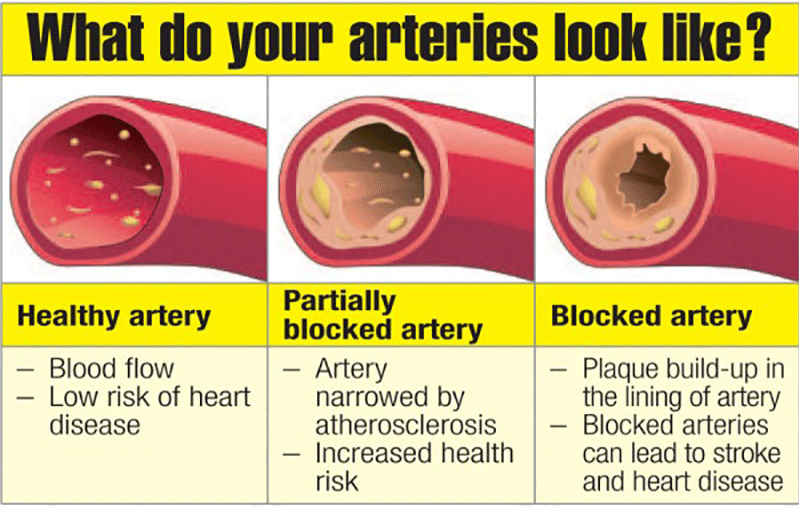
Through time and neglect (such as smoking and not exercising, for example), your arteries can become clogged, brittle and otherwise damaged. Healthy arteries are flexible and elastic, which help them to push blood to and from the heart. However, over time, the walls in your arteries can become rigid and inflexible, which is known as hardening of the arteries.Arteriosclerosis occurs when arteries become thick and stiff, which can restrict blood flow to your organs and tissues.Atherosclerosis refers to the buildup of plaques — such as fats, cholesterol, calcium and other substances in and on your artery walls — which can also restrict blood flow. These plaques can trigger blood clots. Consequently, atherosclerosis can lead to serious problems, including heart attack, stroke, or even death.Atherosclerosis may start with damage or injury inside an artery, which can be caused by high blood pressure, high cholesterol, high triglycerides, diabetes and smoking. Blood cells and plaques can lump together at the injury site, building up inside the artery. This causes the arteries to harden and narrow, restricting blood flow.The good news is that atherosclerosis is treatable and may even be preventable. Exercise, a healthy diet and weight management can all treat atherosclerosis and help prevent it. Of course, exercise is known to aid weight loss, but it has numerous additional benefits for the heart and arteries, as well.As you age, your arteries become stiffer, stickier and narrower. But scientists in Italy found that in people who exercised regularly, age had a much smaller effect on their arteries.Exercise keeps arteries healthy by lowering bad cholesterol and boosting good cholesterol. Regular low or moderate-intensity exercise can reduce levels of LDL (bad) cholesterol and fat in your blood and arteries. More intense levels of exercise can raise HDL (good) cholesterol, which protects your heart.Exercise also reduces other risk factors for atherosclerosis and blood clots, such as high blood pressure, diabetes, obesity and stress.Additionally, exercise has been shown to reduce inflammation in the arteries and to help keep blood vessels flexible and open. Flexible arteries are elastic and able to stretch, allowing more blood to flow when it’s needed.This enables your body to maintain its blood pressure level at normal levels, even during exercise or stressful events, which eases the pressure on your cardiovascular system.The American Heart Association and the Centers for Disease Control and Prevention recommend at least 30 minutes of moderately intense exercise almost every day to make sure that your body remains healthy.Find exercises that you enjoy and then commit to a long term, regular program. Whatever you do, just get in motion and stay in motion. -

Exercise Can Help Prevent and Treat High Blood Pressure
Hypertension (aka, high blood pressure) is an epidemic in the United States, with nearly half of us affected by it.
For decades, high blood pressure has been determined by a top reading of at least 140 and/or a bottom one of 90.However, a dozen medical groups have now dropped the threshold to 120 over 80. Under these new guidelines, 46 percent of American adults have high blood pressure, according to the American Heart Association (AHA).The change has tripled the number of men under 45 and doubled the number of women under 45 with the diagnosis.Hypertension quietly damages blood vessels and leads to serious health problems. Left untreated, hypertension increases the risk of heart disease and stroke, which are the No. 1 and No. 5 causes of death in the US.Aside from heart attack/failure and stroke, high blood pressure can also lead to vision loss, kidney disease or failure, peripheral artery disease and sexual dysfunction.Symptoms of high blood pressure include dizziness, blurred/double vision, headache and neck pain. Some people also experience drowsiness and difficulty breathing. These problems often arise when the blood pressure is too high.However, since high blood pressure is a largely symptomless disease, millions of people are unaware that they have the condition. This is why hypertension is referred to as the “silent killer.” Many people with high blood pressure don’t even know they have it, according to the AHA.The only way to know if you have high blood pressure is to have your blood pressure tested. Though you can test your blood pressure at home with a store-bought arm cuff/monitor, a diagnosis of high blood pressure must be confirmed by a medical professional.Your blood pressure is recorded as two numbers. Systolic blood pressure (the upper number) indicates how much pressure your blood is exerting against your artery walls when your heart beats. Diastolic blood pressure (the lower number) indicates how much pressure your blood is exerting against your artery walls while your heart is resting between beats. These numbers measure millimeters of mercury, shown as mm Hg.Health professionals generally pay more attention to systolic blood pressure (the top number) as a major risk factor for cardiovascular disease for people over 50. In most people, systolic blood pressure rises steadily with age due to the increasing stiffness of large arteries, the long-term build-up of plaque and an increased incidence of cardiac and vascular disease.However, according to the AHA, elevated systolic or diastolic blood pressure alone may be used to make a diagnosis of high blood pressure. And, according to recent studies, the risk of death from ischemic heart disease and stroke doubles with every 20 mm Hg increase in systolic pressure or 10 mm Hg increase in diastolic pressure among people from age 40 to 89.The guidelines set new categories and get rid of “prehypertension”:• Normal: Under 120 / 80• Elevated: Top number 120-129 and bottom less than 80• Hypertension Stage 1: Top of 130-139 or bottom of 80-89• Hypertension Stage 2: Top at least 140 or bottom at least 90These new guidelines mean that 46 percent of U.S. adults have high pressure (stages 1 or 2).High blood pressure interacts with other major risk factors, such as diabetes and high levels of cholesterol, to amplify the risk of heart attack and stroke. Treatment for hypertension must begin early to prevent organ damage.High blood pressure develops slowly over time and can progressively worsen with age. Roughly half the people with untreated hypertension die of heart disease related to poor blood flow (ischemic heart disease) and another third die of stroke, according to the Mayo Clinic.While there is no cure for hypertension, changes in lifestyle can help you lower your blood pressure and keep it down.Remember that drinking more than moderate amounts of alcohol can raise blood pressure by several points, while also reducing the effectiveness of blood pressure medications.Using tobacco can also cause your blood pressure to increase and can contribute to damaged arteries. Too much stress may also contribute to increased blood pressure.Carrying too much weight puts an extra strain on your heart and circulatory system, which can cause serious health problems. Excess weight also increases your risk of cardiovascular disease, diabetes and high blood pressure. Losing just 10 pounds can help reduce your blood pressure.Maintain a healthy weight by eating a nutritious diet, rich in whole grains, fruits, vegetables and low-fat dairy products, but low in salt, saturated fat and cholesterol.Consistent exercise is also vital to lowering blood pressure and maintaining good health. Physical activity not only helps control high blood pressure and manage your weight, it also helps you strengthen your heart and lower your stress level. A healthy weight, a strong heart and general emotional health are all good for your blood pressure.Regular physical activity makes your heart stronger. If your heart works less to pump blood, the force on your arteries decreases, lowering your blood pressure. Exercise also lowers blood pressure by alleviating blood vessel stiffness so that blood flows more freely. Regular exercise can lower your systolic blood pressure by an average of 4 to 9 millimeters of mercury (mm Hg).On the other hand, inadequate physical activity increases your risk of developing high blood pressure. It can’t be overstated that physical activity is great for your heart and circulatory system, including blood pressure. It’s important to be consistent because if you stop exercising, your blood pressure can rise again.If you have slightly high blood pressure (prehypertension), exercise can help you avoid developing full-blown hypertension. If you already have hypertension, regular physical activity can bring your blood pressure down to safer levels.To improve overall cardiovascular health, the American Heart Association, the Surgeon General and the CDC all suggest at least 150 minutes per week of moderate-intensity exercise, or 75 minutes a week of vigorous-intensity exercise, or an equivalent combination of both. The easiest way to think of it is 30 minutes per day, at least five days per week.The best types of exercise for lowering blood pressure include walking, jogging, cycling, swimming or even dancing. Strength training can also help reduce blood pressure.The important thing is to find activities that you enjoy. Then get in motion and stay in motion. -

What are Your Resting, Maximum and Target Exercise Heart Rates?
People often ask me what a normal heart rate is. In adults, resting heart rate ranges from 60 to 100 beats per minute (BPM). Heart rate varies with age, the amount of physical activity a person engages (fitness level) and/or the presence of heart disease.Generally, a lower heart rate at rest implies more efficient heart function and better cardiovascular fitness. For example, a well-trained athlete might have a resting heart rate closer to 40 BPM.Regular exercise improves the heart’s ability to pump the same amount of blood with less effort, which naturally decreases the resting heart rate.A sedentary adult may have a resting heart rate of 70 to 80 BPM, while an adult who performs regular physical activity might have a resting heart rate of 50 to 60 BPM.The following table shows the normal resting heart rate for men:between 18 and 25 years between 26 and 35 years between 36 and 45 years Excellent 49-55 bpm 49-54 bpm 54-59 bpm Good 57-61 bpm 57-61 bpm 60 to 62 bpm Below average 71 to 73 bpm 72 to 74 bpm 73-76 bpm The following table shows the normal resting heart rate for women:
between 18 and 25 years between 26 and 35 years between 36 and 45 years Excellent 54 to 60 bpm 54-59 bpm 54-59 bpm Good 61 to 56 bpm 60 to 64 bpm 62 to 64 bpm Below average 74 to 78 bpm 75 to 76 bpm 74 to 78 bpm Your maximum heart rate (MHR) is genetically fixed and declines over time, as you age. It does not change as you become more or less fit.Maximum heart rate does not determine your fitness level; being able to sustain your MHR for longer and longer periods does.Only a highly motivated and very fit individual is able to reach their maximum heart rate while exercising, and even they can only do it for for a couple of minutes at a time — tops. These individuals have the ability to tolerate great discomfort and even pain.An untrained, unfit individual may find that basic tasks, such as walking, are highly taxing. These people are unfamiliar with the notion of exercising at, or near, maximum heart rate. As a result, they may find that exercising at even 75 percent of maximum is very strenuous and might confuse that with their maximum.A fit person is able to tolerate longer periods of exercise at their maximum heart rate than an unfit person, and he/she also requires a higher intensity of exercise to achieve their MHR than an unfit person.So, how do you calculate your maximum heart rate? The equation that has long been used is 220 – age = maximum heart rate (MHR). However, that formula has long been known to be inaccurate since it was derived from young athletes, who do not represent the general population. A revised formula for MHR is 208 – 0.7 (age).For example:- The MHR a 30-year-old is 208 – 0.7 x 30 = 187 beats per minute.
- The MHR for a 40-year-old is 208 – 0.7 x 40 = 180 beats per minute.
- The MHR for a 50-year-old is 208 – 0.7 x 50 = 173 beats per minute.
Determining your target training heart rate also varies according to age and fitness level. Most people will exercise at a target heart rate that ranges from 50 percent to 85 percent of their maximum heart rate.For example, if you want to exercise at 80 percent of your maximum heart rate, multiply your maximum by .80. For a 40-year-old, the target heart rate would be 180 x .80, or 144 beats per minute.The American Heart Association and the Centers for Disease Control and Prevention recommend the following target heart rate guidelines:- Moderate exercise intensity: 50 to 70 percent of your maximum heart rate
- Vigorous exercise intensity: 70 to 85 percent of your maximum heart rate
The American College of Sports Medicine provides its own guidelines:
- Beginners — 50 to 65 percent of maximum heart rate
- Intermediate level exercisers — 60 to 75 percent of maximum heart rate
- Established aerobic exercisers — 70 to 85 percent of maximum heart rate
It should be noted that maximum heart rate is a predicted number and many people (more than 40 percent of patients, according to one cardiologist, who spoke to the NY Times) can get their heart rates to more than 100 percent of their predicted maximum. Some people’s maximum heart rate can be as much as 15 to 20 beats per minute higher than the predicted maximum.Using a heart rate monitor (which has become quite prevalent) is a great way to gauge your heart rate while exercising.If you don’t have a heart monitor, you can simply use Rated Perceived Exertion. The RPE scale, which ranges from 0 – 10, is used to measure the intensity of your exercise.For example, 0 equates to no exertion at all, or how you feel when sitting in a chair; 10 is very, very intense, or how you feel at the end of an exercise stress test or after a very strenuous activity.The Cleveland Clinic offers this explanation:2 – Light3 – Moderate4 – Somewhat heavy5 – Heavy6 – Heavy7 – Very heavyIn most cases, you should exercise at a level perceived as 3 (moderate) to 4 (somewhat heavy). If you’re doing interval training, an RPE of at least 7 would be appropriate.No matter what you do or how you measure it…. Get in Motion. Stay in Motion. -

Proper Hydration Vital to Good Health and Exercise
Water is your body’s principal chemical component and constitutes about 60 percent of your body weight. Every system in your body depends on water. Lack of water can lead to dehydration, which prevents your body from carrying out normal functions. Even mild dehydration can drain your energy, create fatigue and even cause headaches and nausea.
Your ability to perform exercise can decline with a very small amount of dehydration. Losing just 2% of your body weight in fluid can decrease performance by up to 25%.Adults produce an average of about 1 – 2 liters of urine per day, depending on their state of hydration, activity level, environmental factors, weight and the individual’s health. But we lose water in more ways than one.In addition to urine, we are constantly losing water through sweat and even breathing. Since the body excretes water to maintain body temperature, we lose even more when we exercise.Sweating is a primary means of thermoregulation, since the evaporation of sweat from the skin has a cooling effect. Hence, in hot weather, or when your muscles heat up due to exertion/exercise, more sweat is produced. All of that water must be replaced.The volume of water lost in sweat daily is highly variable, ranging from 100 milliliters to 8 liters per day. Maximum sweat rates of an adult can be up to 2-4 liters per hour or 10-14 liters per day. However, during average intensity exercise, sweat loss can average up to 2 liters of water per hour.So how much water do you need to consume to offset these losses?The Institute of Medicine says adult men actually need about 13 cups (3 liters) of fluid per day, while adult women need about 9 cups (2.2 liters) of fluid (you get about an additional 2 1/2 cups of fluid from foods). The bigger you are, the more water you need. And if you exercise, you need even more water.In the summertime, or if you live in a warm climate, you’ll also need to drink more water than the recommended amount. That’s because heat can make you sweat more and lose fluids faster.Monitor your urine color will tell you how hydrated you are. Lighter urine color means you’re generally well-hydrated. If it’s darker, you are most likely dehydrated.Older adults are more likely to become dehydrated because their sense of thirst declines. Pregnant women and nursing mothers need slightly more water. Additionally, some medications, such as antihistamines and certain antidepressants, increase your fluid needs too.Alcohol, particularly at high doses, can cause you to excrete more than you consume. One drink, especially of beer, won’t do much (it’s about 92 percent water), but wine and hard liquor have more of a dehydrating effect because of their higher alcohol content.It’s not only important to drink water during your workout, but also before your workout. You must pre-hydrate to prepare for exercise. The reality is that it’s important to drink water before, during and after your workout. If you start out dehydrated, you won’t have a good workout. You’ll feel lethargic and perhaps even dizzy. Your body simply won’t function well.If you are well hydrated, you’ll feel stronger and will be able to work out longer and more effectively. That’s because the heart doesn’t have to work as hard to pump blood through the body.So, how much water do you need before and during exercise? Follow this formula:• One to two hours before your workout, drink 16 to 20 ounces of water• 15 minutes before you begin, drink between 8 and 10 ounces of water• During your workout, drink another 8 ounces every 15 minutes.If you hydrate accordingly, you’ll get so much more from your exercise, and you’ll be safer too.