Category: repair

  • Honor Your Body Clock, Create Circadian Alignment

    Honor Your Body Clock, Create Circadian Alignment

    Scientists have isolated the body-clock genes that control 24-hour light-dark circadian rhythm, and it’s now known that every cell in the body has a synchronized clock. 
     
    The 2017 Nobel Prize in Physiology and Medicine was awarded to three scientists who discovered the body clock gene and its critical role in metabolic function. In a world of 24/7 non-stop chaotic eating, relentless stress, continuous screen-gazing, sedentary lifestyle and sleep deprivation, time has become irrelevant. These constant 21st century disruptions of the powerful cellular body clock cycles (aka, circadian rhythm) are wreaking life-threatening havoc on mental and physical health, resulting in obesity, metabolic syndrome, cancer and diabetes.
     
    “We didn’t realize at the time that this clock would be represented all over the body in many different tissues and control so many different biological processes that we go through every day,” says Michael Young MD, 2017 Nobel Laureate in Medicine and Physiology. “It left us with the understanding that our whole bodies are rhythmically active.”  
     
    Circadian Alignment is when the central and peripheral clocks are aligned: bright light during daytime, sleep at night, and food intake during daytime. Circadian Misalignment is when the central and peripheral clocks are misaligned: light at night, sleep during daytime, and food intake at night.
     
    This misalignment has become normalized. According to a recent study of the eating habits of more than 34,000 U.S. adults, nearly 60 percent said it was normal for them to eat after 9 p.m. 
     
    Yet, time-restricted eating (12-16 hours of non-eating) has proven to be the best match to our circadian clocks. This means we need to eliminate nocturnal eating. We should stop eating by 6-7pm and not eat again for at least 12 hours (14 hours is the sweet spot).
     
    Our bodies have evolved to process nutrients during the day, and to conserve energy at night. The body uses energy to repair all of its systems at night, while we sleep. Disrupting that natural rhythm can cause problems.
     
    Several studies have found, for instance, that eating dinner within three hours of bedtime may worsen heartburn or acid reflux symptoms. And limited research has suggested that eating one to three hours before bedtime is associated with more disrupted sleep.
     
    The most intriguing research on late-night eating, however, has focused on its relationship with body weight and metabolic health.
     
    In one 2019 study of nearly 900 middle-aged and older U.S. adults, researchers at Brigham and Women’s Hospital in Boston found that those who consumed roughly 100 calories or more within two hours of bedtime were about 80 percent more likely to be overweight or to have obesity than those who did not eat during that window. Researchers have found similar results in adults in Sweden and Japan.
     
    And in a 2023 study of more than 850 adults in Britain, those who regularly snacked after 9 p.m. had higher levels of HbA1c, a marker for diabetes risk, and greater spikes in blood sugars and fats after daytime meals than those who did not typically consume late-night snacks.
     
    Research has also found that carbohydrates consumed in the evening result in greater blood sugar spikes than those consumed earlier in the day. That is in part because melatonin, a sleep-promoting hormone that increases in the evening, dampens the secretion of insulin, which regulates blood sugar levels. Elevated blood sugars could eventually damage blood vessels and increase the risk of developing high blood pressure and Type 2 diabetes.
     
    Research suggests that it’s best to avoid eating for three to four hours before your usual bedtime. We should be eating during an 8-12 hour window, allowing 12-16 hours for regeneration. We should also be sleeping for 7-8 hours each night. 
     
    A regular bed time is critical for your health and wellness, as is a regular waking time. Additionally, sleeping too long can affect your ability to fall asleep that night. After a good night’s sleep, most people need to be awake around 16 hours before they feel sleepy again.
     
    Going to sleep between 10:00 pm and 11:00 pm is associated with a lower risk of developing heart disease compared to earlier or later bedtimes, according to a recent study by the European Society of Cardiology. Early or late bedtimes may be more likely to disrupt the body’s circadian clock, with adverse consequences for cardiovascular health, according to the study’s authors.
     
    The incidence of cardiovascular disease was highest in those with sleep times at midnight or later (25% higher risk) and lowest in those with sleep onset from 10:00 to 10:59 pm. There was also a 24% higher risk for falling asleep before 10:00 pm. Yes, the body clock is that precise and sensitive. 
     
    Humans are not nocturnal animals; we are diurnal. We need to honor our innate body clock by eating and sleeping in a manner that naturally suits us and promotes health.

  • How to Slow Your Heart Rate and Promote Feelings of Calm

    How to Slow Your Heart Rate and Promote Feelings of Calm

    Our breath is the fundamental element of our life.
     
    Most people can comfortably hold their breath for 30 to 60 seconds. Some can safely hold it for as long 2 minutes. However, permanent brain damage usually begins after only 4 minutes without oxygen, and death can occur as soon as 4 to 6 minutes after that.
     
    Obviously, our breath is vital. Yet, we’re rarely conscious of it. Breathing is part of the autonomic nervous system, meaning that it is automatic and unconscious. The autonomic nervous system has two primary branches: The sympathetic nervous system and the parasympathetic nervous system.
     
    The sympathetic nervous system prepares the body for the “fight or flight” response during any potential danger. On the other hand, the parasympathetic nervous system inhibits the body from overworking and restores it to a calm and composed state. So, we can think of the sympathetic nervous system as the gas pedal and the parasympathetic nervous system as the brake pedal.
     
    The breath is really the quickest and most efficient way to affect and control the nervous system. By extending the exhalation longer than the inhalation, you generate parasympathetic activation and often a soothing, calming, steadying effect. This natural phenomenon is called respiratory sinus arrhythmia. As you exhale, the vagus nerve will slow down the heartbeat.
     
    So, consciously slowing your breath can ease the parasympathetic nervous system, which can slow your heart rate and promote feelings of calm.
     
    Studies have found that breathing practices can help reduce symptoms associated with anxiety, insomnia, post-traumatic stress disorder (PTSD), depression, and attention deficit disorder (ADD).
     
    Normal respiration rates for adults at rest range from 12 to 16 breaths per minute, according to Johns Hopkins. It should be noted that 12 breaths per minute amounts to one breath every 5 seconds. Exceeding 12 breaths per minute is a sign of quick and shallow breathing.
     
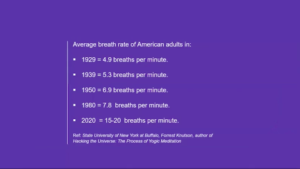
    Unfortunately, we breathe a lot faster than previous generations did, and it’s really not good for us. Most American adults now breathe at a rate of 15-20 per minute. Yet, any breath rate above 12 per minute activates the sympathetic nervous system (fight or flight). This means that most of us are in a constant state of fight or flight activation simply due to the way we breathe.
     
    Scientists are finding that breathing at the rate of about six exhalations per minute can be especially restorative, triggering a relaxation response in the brain and body. Some people can reduce their respiratory rate to this level using slow, mindful breathing techniques. 
     
    There is a direct relationship between respiration rate and heart rate. Exhalation – particularly when sustained longer than inhalation – slows your heart. Meanwhile, inhalation accelerates your heart. And the more your heart beats, the more respiration occurs. As the heart beats faster, it uses more energy and sends more oxygen to the body. For example, during exercise the respiratory rate will increase to about 40–60 breaths per minute.
     
    Breathing with your mouth, especially when you’re not exercising vigorously, is a sign of dysfunctional breathing.
     
    Nose breathing is more beneficial than mouth breathing, which is unnatural. Breathing through your nose can help filter out dust and allergens, boost your oxygen uptake, and humidify the air you inhale. Mouth breathing, on the other hand, can dry out your mouth, which may increase your risk of bad breath and gum inflammation.
     
    The nose produces nitric oxide, which improves your lungs’ ability to absorb oxygen. Nitric oxide also increases your ability to transport oxygen throughout your body, including inside your heart. It relaxes vascular smooth muscle and allows blood vessels to dilate.
     
    Nitric oxide is also antifungal, antiviral, antiparasitic, and antibacterial. Simply put, it helps the immune system fight infections.
     
    It is also believed that you absorb oxygen around 15 percent better when you exhale through your nose when compared to mouth breathing.
     
    So, breathing with your nose is preferable in many ways. Meanwhile, mouth breathing, as previously stated, is a sign of dysfunctional breathing.
     
    Inhaling with your chest is another common sign of dysfunctional breathing. If you notice that your chest is the first thing to move when you begin inhaling, it’s a sign that you’re engaging in shallow, upper chest breathing.
     
    A shallow or a quick breathing pattern is a sign that your diaphragmatic muscles may not be actively stabilizing your trunk, which can lead to poor posture and instability in your low back.
     
    Poor diaphragmatic control can cause the muscles in your chest and the front of your shoulders to become short and tight. If you find yourself slouching your head or shoulders forward, this can be a sign that you’re not activating your diaphragm when you breathe.
     
    You should be able to limit shoulder movement while breathing, keeping the shoulders from elevating. Elevating your shoulders when breathing causes upper chest breathing.
     
    Tight neck, chest, and shoulder muscles can cause shallow breathing. If you carry lots of tension in your shoulders and neck, this can be a sign that you engage in stressed and shallow breathing.
     
    Practice contracting your abdominal muscles as you breathe. Using your abdominals (part of your core) can help you breathe better. You should feel your abdominal muscles moving in and out as you breathe.
     
    A healthy breathing pattern allows your body to maintain a high metabolism and deliver oxygen to vital tissues. Shallow breathing increases both blood pressure and heart rate. In addition, if you breathe too fast or don’t inhale deeply enough, you can increase the pH of your blood, which can decrease the amount of blood getting to your brain and muscles, and result in less oxygen being released by the blood. This can make you feel tired and fatigued.
     
    So, though we typically take breathing for granted and pay little, if any, attention to it (unless we’re exercising), it really is a critical and fundamental element to good health and lower stress levels.
     
    The fact that slow, measured breathing can slow heart rate, promote feelings of calm, and help reduce symptoms associated with anxiety, insomnia, PTSD, depression, and ADD is all the reason we need to begin a regular, deliberate practice. Begin with the following:
     
    1. While standing or sitting, draw your elbows back slightly to allow your chest to expand.
     
    2. Take a deep inhalation through your nose for a count of four.
     
    3. Retain/hold your breath for a count of four.
     
    4. Using your belly muscles, exhale through your nose for a count of eight.
     
    5. Continue to breath like this for 2-5 minutes. See if you can eventually work your way up to 10 minutes.
     
    Utilizing this method should bring your breathing down to a rate of about six exhalations per minute, which scientists are finding to be especially restorative, triggering a relaxation response in the brain and body.
     
    Another useful technique is alternate nostril breathing, known as pranayama in India. This yogic technique also promotes relaxation and lowers heart rate.
     
    Alternate nostril breathing is best practiced on an empty stomach. Avoid the practice if you’re feeling sick or congested. Keep your breath smooth and even throughout the practice.
     
    1. Choose a comfortable seated position.
     
    2. After an exhale, use your right thumb to gently close your right nostril.
     
    3. Inhale through your left nostril and then close your left nostril with your middle or index finger.
     
    4. Release your thumb and exhale out through your right nostril.
     
    5. Inhale through your right nostril and then close this nostril.
     
    6. Release your finger to open your left nostril and exhale through this side.
     
    7. This is one cycle.
     
    8. Continue this breathing pattern for up to 5 minutes.
     
    9. Finish your session with an exhale on the left side.
     
    You can utilize these techniques any time you’re feeling stressed or anxious throughout the day. Try them both, or least one, every day. Naturally, you should discontinue these practices if you experience any feelings of discomfort or agitation.
  • The Benefits of Whey Protein, and Why You Should Supplement

    The Benefits of Whey Protein, and Why You Should Supplement

    According to the Institute of Medicine, we all should consume between 10% to 35% of our daily calories from protein. Athletes and those who engage in regular strength training should aim toward the higher end of that range.  
     

    Though proteins are best derived from whole foods, if your diet is solid and you’re simply trying to add a protein supplement between meals, protein powder can be a useful addition to your diet.

    Most people eat about 10% of their protein at breakfast, about 20% at lunch and about 70% at dinner. However, protein intake should be spread out more evenly to increase protein synthesis, and protein powder can help you achieve that goal. What type of protein powder, you ask?


    Whey is one of the richest sources of branched-chain amino acids (BCAAs), including leucine, isoleucine and valine. These three gems have been shown to be absolutely critical for muscle growth, and even energy during workouts.

    Whey protein also provides antioxidant benefits, boosts immune function, and enhances muscle recovery and growth.

     
    Whey is the liquid remaining after milk has been curdled and strained. The most common whey protein foods include dairy foods such as yogurt, cottage cheese and ricotta.
     

    When you were a kid and read about Little Miss Muffet “eating her curds and whey,” she was actually eating cottage cheese, a great source of whey protein.

    Yet, many athletes and exercisers ingest much of their whey in the form of protein powder. However, not all whey protein powders are created equally. Some are made from concentrates, which are high in lactose.

    If you are lactose intolerant or can’t digest lactose properly (i.e., you get stomach cramps, gas and diarrhea), but you want a high-quality protein powder with excellent bioavailability, you might try a 100% whey protein isolate powder.

    The amount of lactose in whey protein isolate is quite low. The processing of whey into 100% isolate removes the lactose, lessening your chance of feeling gassy and bloated.

    What separates whey protein from other forms of protein is its digestion rate; whey digests very rapidly. In fewer than 30 minutes it can fast-track a good portion of its amino acids to your muscles, and that rapid delivery of aminos to muscle cells has been shown to be important for enhancing muscle growth.

    To be considered a great, whey protein the product MUST list whey protein isolate or hydrolyzed whey protein isolate as the very first ingredient. That’s because whey protein isolates are the purest form of protein you can get, with some being more than 90% protein. And “hydrolyzed whey protein isolate” means that high-quality whey has been pre-digested into smaller protein fragments for even faster digestion than regular whey isolate.


    Whey protein concentrate, on the other hand, goes through less filtering, which means fewer of the natural carbohydrates found in milk are removed. The result is a whey product that is much lower in protein content. Although most whey protein concentrates are somewhere between 70-80% protein, some can be less than 35% protein. This is why isolates and hydrolysates generally cost more.

    In order to know if a whey protein powder is top notch, you’ll need to do some math. Take the grams of protein per serving listed on the supplement facts panel and divide it by the serving size (in grams). This will give you the percentage of protein in each serving. To be considered a great whey protein powder, the percent protein per serving (or scoop) should be 80% or greater.

     
    If you are vegan, you might choose a non-dairy protein powder, preferably the organic variety. Pea protein powder and soy protein isolate are good choices. However, it’s important to recognize that not all plant proteins contain each of the nine essential amino acids (EEAs).
     
    EEAs cannot be made by the body. As a result, they must come from food. Animal-based foods have all nine of the EAAs and they are also higher in bioavailability, which is their ability to be absorbed and used by the body. Plant-based foods have lower bioavailability. 
     
    Soy is the only complete plant protein. Soy foods are also rich in vitamins and minerals. 
     
    It’s worth noting that plant proteins generally have less leucine, which is an essential amino acid. Leucine can: increase muscle growth and lean body mass, help in healing skin and bonesincrease production of human growth hormone (HGH), and may help control blood sugar.
     
    However, the following protein powders are good plant-based sources of leucine:
     
    • Soy protein isolate
    • Pea protein powder
    • Peanut powder
     
    Nonetheless, because it contains all of the essential amino acids and is easily digested, whey protein (including whey protein powder) is considered the gold standard. Add in the facts that whey protein can aid wound healing, boost immune function, provide antioxidant benefits, moderate blood sugar, and might even lower blood pressure, and whey protein should be your go-to powder. 
     
    Yet, what likely matters most to athletes and weight trainers is that whey is a complete, high-quality protein that promotes muscle growth. To that end, some studies show that whey protein may be slightly better than other types of protein, such as casein or soy.
     
    When choosing a hydrolyzed whey protein isolate, make sure to select one with no additives, preservatives or artificial sweeteners. You might want a natural vanilla or chocolate flavor, for example, but you don’t need any of the other junk that may be added. If the only ingredient is whey protein isolate or hydrolyzed whey protein, you’re getting purity, without any other fillers or low-quality garbage. 
  • For Exercisers, Prepare & Repair

    For Exercisers, Prepare & Repair

    Diet and nutrition are the critical counterpoints to a regular exercise program. Both proteins and carbohydrates are essential for preparing for your workouts, as well as for recovering from them.
     
    To feed the rigorous demands of working out, you need to prepare your body for exercise and then repair it from the associated stresses. Proteins and carbs provide both the fuel that drives you during your workouts, as well as the building blocks that help you recover.
     
    If you don’t eat before exercise, you won’t have adequate fuel to get you through an intense workout. Instead, you’ll feel tired and weak and have limited endurance. That’s because complex carbs provide the energy that fuels muscle contractions.
     
    Carbohydrates are broken down by the body into glucose, which is used as energy. Any glucose not immediately used is stored in the muscles and the liver, in the form of glycogen.
     
    Glycogen is the source of energy most often used for exercise. Because it is immediately accessible, glycogen is used for any short, intense bouts of exercise, from sprinting to weight lifting. Glycogen also supplies energy during the first few minutes of any sport. Though fat helps to fuel activity during long, slow-duration exercise, glycogen is still needed to help break down the fat into something the muscles can use.
     
    Adequate carbohydrate intake also helps prevent protein from being used as energy. If the body doesn’t have enough carbohydrate, protein is broken down to make glucose for energy. That’s undesirable because proteins are the building blocks for muscles, bones and other vital tissues.
     
    Though carbohydrates are the human body’s key source of energy, not all carbs are created equally. Simple carbohydrates, or sugars, can cause a spike in blood sugar, thereby stimulating excess insulin production, which causes a fast drop in blood sugar. This creates a vicious cycle of hunger and eating, followed by more hunger and more eating. Stick with complex carbohydrates of the fibrous variety, such as legumes, brown rice, whole oats, and vegetables. These are digested slowly and do not cause a spike in blood sugar (glucose).
     
    Depending on your ability to break down food, you need at least an hour, perhaps 90 minutes, to properly digest before commencing exercise. You only need a small amount of food (about 200 calories), primarily consisting of carbohydrates. Small portions of food are easily broken down and digested, providing more immediate energy.
     
    However, carbohydrates are also vital in the post-workout period. Eating carbs in your post-training meal will kick-start the muscle-building process. If you lack carbohydrates, you’ll fail to support the growth process. That’s because muscle glycogen not only provides fuel for hard training, but it also supports recovery.
     
    Carbohydrates directly support muscle-building by fueling muscles and helping them to remain anabolic. Energy-starved muscles quickly fall out of an anabolic state and fail to grow. Carbs also create a special hormonal environment that plays a critical role in growth — they initiate the release of insulin, which increases protein uptake by muscles. Insulin also helps muscles take in testosterone, the body’s chief muscle-building hormone.
     
    Carbohydrates aren’t just the most important nutrient for exercising muscles; they are essential for brain and CNS function.
     
    Consume at least 50 grams of carbohydrates (in addition to protein) in the meal following your workout to kick-start the rebuilding process. If you don’t gain body fat from eating that much, boost it to 70-80 grams.
     
    Also, be sure to eat an adequate portion of protein in your post-training meal; anywhere from 70-100 grams should be sufficient for muscle repair.and growth.
     
    Protein ingestion also helps athletes recover from exercise. After all, proteins are the building blocks of muscle tissue. They aid in the repair of exercise-induced damage to muscle fibers. Unless a protein-containing meal is consumed during the recovery period, muscle breakdown will exceed muscle synthesis, resulting in the loss of muscle mass.
     
    Some proteins digest faster than others. Whey protein, egg whites and some fish rapidly reach the bloodstream, while casein protein, red meat, poultry and whole eggs are slower. Faster-digesting proteins are best in the morning to reverse the overnight fast when the body sometimes falls out of a growth state. They’re also best before and after training, when the body needs immediate sources of protein to help prevent muscle breakdown. At other times of day, slower-digesting proteins do just fine.
     
    Proteins and carbohydrates are best eaten together because they work synergistically, upgrading the ability to drive amino acids into muscles and resulting in growth.
     
    Adults should get 45 percent to 65 percent of their calories from carbohydrates, 20 percent to 35 percent from fat, and 10 to 35 percent from protein, according to the National Academy of Science.
     
    A triathlete, marathoner of other endurance athlete might get 60 percent of their daily calories from carbohydrates and 20 percent each from fats and proteins. But a dedicated weight trainer or body builder may lower the percentage of carbs and increase the percentage of protein, finding a balance more along the lines of 50 percent carbohydrates, 20 percent fat and 30 protein.
     
    Some people might have a hard time breaking their daily macronutrient intake into percentages. For these people, keeping track of their total protein ingestion might be easier.
     
    The Recommended Daily Allowance (RDA) for protein for persons over 18 years of age, irrespective of physical activity status, is 0.8 gram per kilogram of body weight per day (1 kilogram equals 2.2 pounds).
     
    However, many sports nutrition experts (American College of Sports Medicine, American Dietetic Association) have concluded that protein requirements are higher for athletes.
     
    The protein recommendations for endurance athletes are 1.2 to 1.4 grams per kilogram of body weight per day, whereas those for resistance and strength-trained athletes may be as high as 1.6 to 1.7 grams per kilogram of body weight per day.
     
    Remember, you’ll get the most out of your training if you prepare for and repair from your workouts. Pushing your body hard to improve health and fitness requires you to nourish it. By giving your body everything it needs, you’ll get the most out of it.