Tag: metabolism

  • Honor Your Body Clock, Create Circadian Alignment

    Honor Your Body Clock, Create Circadian Alignment

    Scientists have isolated the body-clock genes that control 24-hour light-dark circadian rhythm, and it’s now known that every cell in the body has a synchronized clock. 
     
    The 2017 Nobel Prize in Physiology and Medicine was awarded to three scientists who discovered the body clock gene and its critical role in metabolic function. In a world of 24/7 non-stop chaotic eating, relentless stress, continuous screen-gazing, sedentary lifestyle and sleep deprivation, time has become irrelevant. These constant 21st century disruptions of the powerful cellular body clock cycles (aka, circadian rhythm) are wreaking life-threatening havoc on mental and physical health, resulting in obesity, metabolic syndrome, cancer and diabetes.
     
    “We didn’t realize at the time that this clock would be represented all over the body in many different tissues and control so many different biological processes that we go through every day,” says Michael Young MD, 2017 Nobel Laureate in Medicine and Physiology. “It left us with the understanding that our whole bodies are rhythmically active.”  
     
    Circadian Alignment is when the central and peripheral clocks are aligned: bright light during daytime, sleep at night, and food intake during daytime. Circadian Misalignment is when the central and peripheral clocks are misaligned: light at night, sleep during daytime, and food intake at night.
     
    This misalignment has become normalized. According to a recent study of the eating habits of more than 34,000 U.S. adults, nearly 60 percent said it was normal for them to eat after 9 p.m. 
     
    Yet, time-restricted eating (12-16 hours of non-eating) has proven to be the best match to our circadian clocks. This means we need to eliminate nocturnal eating. We should stop eating by 6-7pm and not eat again for at least 12 hours (14 hours is the sweet spot).
     
    Our bodies have evolved to process nutrients during the day, and to conserve energy at night. The body uses energy to repair all of its systems at night, while we sleep. Disrupting that natural rhythm can cause problems.
     
    Several studies have found, for instance, that eating dinner within three hours of bedtime may worsen heartburn or acid reflux symptoms. And limited research has suggested that eating one to three hours before bedtime is associated with more disrupted sleep.
     
    The most intriguing research on late-night eating, however, has focused on its relationship with body weight and metabolic health.
     
    In one 2019 study of nearly 900 middle-aged and older U.S. adults, researchers at Brigham and Women’s Hospital in Boston found that those who consumed roughly 100 calories or more within two hours of bedtime were about 80 percent more likely to be overweight or to have obesity than those who did not eat during that window. Researchers have found similar results in adults in Sweden and Japan.
     
    And in a 2023 study of more than 850 adults in Britain, those who regularly snacked after 9 p.m. had higher levels of HbA1c, a marker for diabetes risk, and greater spikes in blood sugars and fats after daytime meals than those who did not typically consume late-night snacks.
     
    Research has also found that carbohydrates consumed in the evening result in greater blood sugar spikes than those consumed earlier in the day. That is in part because melatonin, a sleep-promoting hormone that increases in the evening, dampens the secretion of insulin, which regulates blood sugar levels. Elevated blood sugars could eventually damage blood vessels and increase the risk of developing high blood pressure and Type 2 diabetes.
     
    Research suggests that it’s best to avoid eating for three to four hours before your usual bedtime. We should be eating during an 8-12 hour window, allowing 12-16 hours for regeneration. We should also be sleeping for 7-8 hours each night. 
     
    A regular bed time is critical for your health and wellness, as is a regular waking time. Additionally, sleeping too long can affect your ability to fall asleep that night. After a good night’s sleep, most people need to be awake around 16 hours before they feel sleepy again.
     
    Going to sleep between 10:00 pm and 11:00 pm is associated with a lower risk of developing heart disease compared to earlier or later bedtimes, according to a recent study by the European Society of Cardiology. Early or late bedtimes may be more likely to disrupt the body’s circadian clock, with adverse consequences for cardiovascular health, according to the study’s authors.
     
    The incidence of cardiovascular disease was highest in those with sleep times at midnight or later (25% higher risk) and lowest in those with sleep onset from 10:00 to 10:59 pm. There was also a 24% higher risk for falling asleep before 10:00 pm. Yes, the body clock is that precise and sensitive. 
     
    Humans are not nocturnal animals; we are diurnal. We need to honor our innate body clock by eating and sleeping in a manner that naturally suits us and promotes health.

  • Stress Can Undermine Weight Loss and Increase Weight Gain

    Stress Can Undermine Weight Loss and Increase Weight Gain

    If you’re a stress eater (i.e., you eat to cope with stress), restricting calories can cause even more stress.

    If you eat a little less than your body needs, it can help you lose weight and body fat without sacrificing performance or wellbeing.

    However, eating a lot less, especially for a long time, and especially when you have major recovery needs—like hard athletic training or recovering from surgery—can actually thwart proper recovery. It can even cause your body to turn down the thermostat, restricting calorie burning. In essence, your body goes into preservation mode.

    Food is meant to nourish the body and the right amounts are vital to athletes. An excessive or chronic caloric deficit can impair performance, decrease lean muscle mass, and lead to a host of other issues ranging from hormonal imbalances to immune deficiencies.

    You need to eat enough to support your physiological needs. Unfortunately, most Americans (truly, the majority) eat well beyond their physiological needs. Stress is a common culprit.

    Cutting too many calories all at once can be very stressful and leave a person feeling like they’re starving. That’s not a formula for successful weight loss or athletic performance.

    It’s best to taper slowly, gradually reducing your caloric intake. Say, for example, that you (or your coach or nutritionist) determine that you should be eating 2,000 calories per day (I chose this because it’s a round number that’s easy to work with). Let’s also say that you discover, through the use of a food app, that you’re actually eating about 2,600 calories per day, which is why you’re overweight. 

    You’re best off tapering to 2,400 calories for about two weeks, and then dropping down 2,200 for another two weeks before finally settling in at your proper intake of 2,000 calories per day. This gradual step-down will keep your body from going into starvation mode and keep you from feeling hungry all the time, which will undermine your efforts. 
     
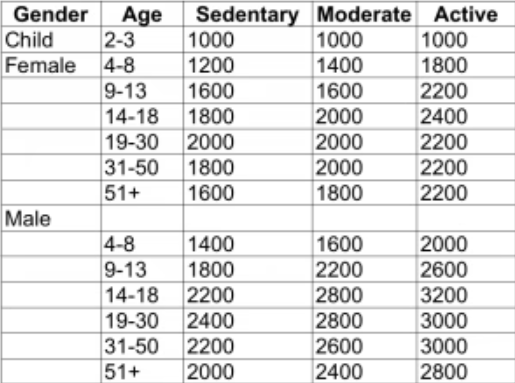
    Calorie requirements are highly individualized. An ideal daily intake of calories varies depending on age, metabolism and levels of physical activity, among other things. The Dietary Guidelines for Americans provide calorie estimates for men and women based on age and activity level. For example, these guidelines note that the general recommended intake for adult women ranges from 1,600 to 2,400 calories daily, while men often require 2,000 to 3,000 calories a day to maintain healthy body weights.  


    Sedentary people need fewer calories because sitting is not very demanding, and most Americans are quite sedentary. According to a study reported by the American College of Sports Medicine, American adults, ages 20 to 75, reported spending an average of 9.5 hours sedentary each day, and most of this time was accumulated at work and during leisure-time. Then factor in that most of us sleep 7-8 hours per night. 
     
    Harvard Medical School says that sedentary adults require 13 calories for each pound of their body weight on a daily basis. For example, a sedentary 130-pound woman needs about 1,700 calories, while a 175-pound, inactive man requires about 2,300 calories daily to maintain a healthy body weight.
     
    Yet, those numbers are to maintain body weight. If you need to lose weight, you’ll need to lower your caloric intake. The University of Washington suggests that overweight adults need 10 calories per pound of their desirable body weight to move toward that healthier weight. For example, an overweight woman with a goal weight of 130 pounds needs 1,300 calories daily, while an obese man trying to reach 175 pounds needs about 1,750 calories daily to reach his goal.
     
    Again, any caloric reduction should be done slowly and gradually. Give your body — particularly your stomach and brain, which communicate hunger signals — time to adapt. Initially, at least, focus on eating slowly and eating more whole foods, instead of just eating smaller portions. After a week or two of these adjustments, you can begin to focus on portion sizes and limiting caloric intake, which should accelerate your weight loss. Being hungry all the time will cause a backlash and result in bad food choices and, ultimately, overeating. 
     
    Highly-processed foods, aka “junk” foods, are typically loaded with sugar, fat, and sodium. Beyond that, they often harm the microbiome, the delicate balance of microorganisms in the gut, which contributes to various health problems. Highly-processed foods are also associated with increased systemic inflammation. 
     
    If you can gradually shift to to eating more whole, minimally-processed foods more often, you’ll be on the right track. Don’t do it all at once and don’t be militant about it. Slowly cut your calories to a number that suits your sex, age and activity level. 
     
    Don’t restrict food to the point that it causes anxiety or stress. That will prove to be unproductive and will undermine your goals. Simply put, don’t deprive yourself. By eating more slowly, and eating foods that are high in protein and fiber, which are more filling, you can become more attuned to hunger sensations and learn to stop before overeating. 
     
    Lastly find healthier ways to cope with stress that don’t involve eating, such as taking a walk, doing a crossword puzzle, talking to a close friend or loved one, or even meditating. Stress is part of life; don’t let it undermine you. 
     
    Be compassionate with yourself. Be on your own side and don’t be so judgmental. Good things — the fruits of your labor — take time to manifest. Keep moving forward and know that your sustained efforts will pay off. Be patient and remain focused. 
  • How Your BMR and RMR Contribute to Your Weight Status

    How Your BMR and RMR Contribute to Your Weight Status

    If you’ve ever weighed yourself before bed at night and again in the morning, you may have been surprised that you lost anywhere from 1-3 pounds. This is fairly normal. We all lose weight at night while sleeping.
     
    How much we lose overnight depends on whether we get enough sleep, how much water we excrete, and our basal metabolic rate (BMR), which is largely determined by the amount of muscle we have (muscle is quite metabolically active).
     
    The body is in an entirely aerobic state while we’re sleeping, since it uses only fat to operate in such a low-energy state (carbohydrates are used only for higher energy demands). Our heart, brain and other organs all need energy to maintain basic functions while we’re sleeping.
     
    In one hour of sleep, most people burn 0.4 to 0.5 calorie for every pound of body weight. For example, a 150-pound person would multiply 150 by 0.4 or 0.5 to get 60 to 75 calories used in one hour of sleep. After eight hours of sleep, that person has burned 480 to 500 calories.
     
    A 200-pound person would burn 80-100 calories per hour, or 640-800 calories during eight hours of sleep.
     
    This may seem unbelievable, but it’s true. You’re burning calories all day long — even while sleeping — just to stay alive; that’s your BMR. Additionally, energy is also expended by digesting your food and from non-exercise daily movements, such as brushing your teeth, getting dressed and pouring your morning coffee. This additional expenditure is known as your resting metabolic rate (RMR).
     
    For American women, the average BMR is 1,493 calories. For American men, the average BMR is 1,662 calories.
     
    Your BMR accounts for about 70 percent of the calories you burn every day (in general, men have a higher BMR than women). This is critically important since there is no way we can exercise away all the calories we consume each day.
     
    Muscle is the single most important predictor of how well you metabolize your food, burn calories, and burn body fat. However, beginning in our late 20s, we start losing muscle, which means our metabolism also starts declining. A consistent weight training program can stop this decline and even reverse it.
     
    There are approximately 3,500 calories in a pound of stored body fat. If you subtract 3,500 calories each week through diet, exercise or a combination of both, you will lose one pound of body weight.
     
    On average, 75 percent of this is fat and 25 percent is lean tissue, which is why it’s so important to strength train while attempting to lose weight; you don’t want to lose your precious muscle along with that unwanted fat. Muscles at rest burn three times more calories than fat, so maintaining or increasing muscle mass influences BMR.
     
    In simple terms, if you’re seeking to lose weight, aim for a 500-calorie deficit each day of the week (7 x 500 = 3,500).
     
    As a guide, the American College of Sports Medicine (ACSM) recommends that women never drop their calorie-intake level below 1,200 per day and men should not go below 1,800 calories per day.
     
    So, back to where we started: it’s possible for a 150-pound person to lose about 1 pound each week simply by sleeping eight hours every night. Remember, a person of this weight burns roughly 500 calories while sleeping each night. Sleep is very valuable!  In fact, sleep deprivation has been linked to an increase in weight.
     
    Clearly, much of this 1-pound of weight loss is water, not just fat (we lose water gradually each night through respiration and perspiration), but burning 500 calories overnight while sleeping is no small matter.
     
    The average person eliminates about 1.2 liters of water in urine each day, and also eliminates about 1 liter a day through perspiration and respiration. That’s 2.2 kilograms (almost 5 pounds) of weight fluctuation happening throughout the day.
     
    So, don’t get caught up in the daily fluctuations of your body weight. You can gain up to 5 pounds during the day just from your food and beverage intake — but it’s not all fat!
     
    Your BMR, non-exercise daily movements, and your daily exercise routine should allow you to at least maintain your present weight. To lose weight, however, you’ll have to reduce your daily caloric intake.
     
    You weigh less in the morning than during the rest of the day because you don’t (normally, at least) eat and drink during the night. Remember that two cups of water (16 ounces or one pint) weighs one pound, so drinking a tall glass of water will temporarily be reflected in your weight.
     
    The most accurate time to weigh yourself is first thing in the morning, when you have an empty stomach. Weighing yourself while naked will also give you a more accurate reflection of your weight. 
     
    Lastly, always weigh yourself on the same scale. Even if it’s off by a pound or so, it will be relative to itself and still reveal any upward or downward movements. Different scales may give you different results, which can be misleading or even maddening.
  • Don’t Fall Prey to Sitting Disease!

    Don’t Fall Prey to Sitting Disease!


    The Benefits of Standing vs Sitting

    The Mayo Clinic conducted a 10-year, $20 million research study on nutrition, activity and behavior related to weight management and obesity prevention.
     
    The research determined that sedentary environments are a primary contributor to the rise in obesity that increases health costs and takes a toll on quality of life.
     
    This research supported the value of N.E.A.T. (Non-Exercise Activity Thermogenesis), which is all the calories one burns while doing normal, non-exercise activity.
     
    Much of our health depends upon adequate, regular movement. In fact, all movement counts toward our health, and non-exercise activity is crucial. Our bodies were designed to move and when we don’t, our physical health deteriorates.
     
    One culprit driving the obesity epidemic is “sitting disease.” Most of us spend 10-15 hours a day just sitting!
     
    No matter how much you exercise, sitting for excessively long periods of time is a risk factor for early death, according to a 2017 study in Annals of Internal Medicine.
     
    There’s a direct relationship between time spent sitting and your risk of early mortality of any cause, researchers said, based on a study of nearly 8,000 adults. As your total sitting time increases, so does your risk of an early death.
     
    The positive news: people who sat for less than 30 minutes at a time had the lowest risk of early death.
     
    Replacing a few hours of sitting at your desk with standing can lead to significant health benefits over time. In addition to the cardiovascular and musculoskeletal benefits, there is also a significant difference in calories burned.
     
    A study by the BBC and the University of Chester found remarkable health benefits of standing versus sitting. Standing caused participants to have a much higher heart rate (around 10 beats per minute higher), which adds up to burning about 50 calories more per hour versus sitting. Over a year, that adds up to about 30,000 more calories or 8 pounds of fat.
     
    There are many documented benefits of standing, such as reducing your risk of type 2 diabetes, cardiovascular disease, certain types of cancer and back pain.
     
    The general rule is to not sit more than 30 minutes without standing or getting up and moving. Set an alarm on your watch, phone or computer to remind you to get up after you’ve been sitting for 30 minutes. Move around or walk for five minutes to help reduce the health risks from all that sitting.
     
    Get in Motion. Stay in Motion.
  • Is Your Weight Training Intensity Adequate?

    Is Your Weight Training Intensity Adequate?

    Through many years at the gym, I’ve often seen women using the same 5-pound dumbbells for a variety of exercises: chess presses, shoulder presses, rows, bicep curls, lateral raises, front raises and more. Since weights should be thought of as tools, this is tantamount to using a screwdriver for every task, when sometimes you need a hammer or a wrench.
     
    For example, the weight you use for a chest press should be heavier than the weight you use for a shoulder press, which should he heavier than the weight you use for a lateral raise.
     
    As you work out consistently, you should grow stronger over time, necessitating the use of heavier weights for each exercise. This is especially true in the early stages of a workout program, when strength gains are most pronounced.
     
    It’s not just women either. I’ve often seen men using the same 25-pound dumbbells for an exercise that they’ve been performing for years. They make no progress because their program is not built on progression.
     
    Your body is a demand-based system. That is, the more you demand of it, the more it will produce. If you don’t steadily, but incrementally, increase the demand, your workouts and your results will stagnate.
     
    Aside from the fact that you shouldn’t be lifting the same exact weight for a variety of exercises, you shouldn’t be lifting the same exact weight for the same exercise, week after week, month after month.
     
    In short, weight training is meant to be progressive. You shouldn’t be lifting the same amount of weight today that you did one year ago. You should have gotten stronger; you should have progressed.
     
    However, sometimes your body needs a break from heavy lifting. Take it easy once a week and work on muscular endurance instead of just strength. Give your muscles a break, while still remaining active in the gym.
     
    How do you know if you are (or are not) using a high enough weight, aka, working out at the proper intensity?
     
    First, let’s define intensity, which is based on the maximum number of repetitions that can be performed with a given weight. The one-repetition maximum (1RM) is an ideal baseline:
     
    • High Intensity = 80–100% of your 1-rep max (1RM); typically 1-5 reps
    • Medium Intensity = 60–80% of your 1-rep max (1RM); 6-12 reps
    • Low Intensity = 10–40% of your 1-rep max (1RM); 15 or more reps
     
    The National Strength and Conditioning Association (NSCA) provides the following guidelines:
     
    • Hypertrophy (muscle growth) = 6-12 RM
    • Strength = 6, or fewer, RM
    • Power = 1-2 RM
     
    In order for your muscles to undergo an adaptation from training (i.e., to grow stronger or bigger), they must be stressed by working against a weight/load/stimulus that is greater than what they are accustomed.
     
    Don’t stop an exercise simply because you have reached 10 or 12 reps. Perform each exercise to the point of momentary muscular failure, whether that’s 12, 10, eight or six reps.
     
    Increasing weight means a reduction of reps. If, for example, you can chest press 40-pound dumbbells 10 times to failure, that means you shouldn’t be able to press 50-pound dumbbells 10 times (if you can, you should be working out with the 50s, not the 40s). It’s likely that you can only press the 50s six times or eight times, or whatever it might be.
     
    If the current weight you are lifting isn’t challenging, you need to increase that weight. Strength training is meant to be challenging, because the whole point is to “overload” your muscles so they become stronger.
     
    Simply put, if you can do more than 12 repetitions, you should increase the weight. Everyone could stand to be stronger. 
     
    If you determine that it’s time to increase your resistance for a particular exercise, do this by adding no more than 10 percent at a time. For example, if you’re currently lifting 50 pounds, you’d increase that by five pounds to 55 pounds. This incremental increase should keep you safe and prevent injury. It’s important to maintain good form with a new, higher weight.
     
    Remember, if you don’t make your muscles work harder than they’re accustomed, they won’t get stronger (which is the whole point). If you train progressively, your muscles will grow stronger in order to meet the increasing demands you are placing on them.
     
    Lastly, recognize that some days you will feel like the Incredible Hulk, while on other days you will feel like a mere mortal. It’s okay; it’s all part of the process. Don’t beat yourself up over a bad training day. We all have them from time to time. 
  • Sleep Vital to Muscle Recovery, Muscle Growth and Weight Management

    Sleep Vital to Muscle Recovery, Muscle Growth and Weight Management


    Since we were children, we’ve all heard the advice that we should get eight hours of sleep each night. With 24 hours in a day, that amounts to a third of the day and, ultimately, a third of our lives.
     
    Unfortunately, most of us are missing the mark.
     
    The National Sleep Foundation recommends 7-9 hours of sleep per night. However, it says that around 40 percent of us get less than 7 hours. Moreover, a survey by Gallup finds that Americans currently average 6.8 hours of sleep at night, down more than an hour from 1942.
     
    Life has gotten faster and more hectic at the expense of our sleep and, ultimately, our health.
     
    Scientists are still discovering the myriad of reasons we need sleep and just how valuable it is. For example, in studies on rats deprived of sleep for just five days, the end result was death. Sleep was found to be as essential as food because the rats died just about as quickly from sleep deprivation as from food deprivation.
     
    For athletes and exercise enthusiasts, sleep is vital to athletic performance, as well as muscle growth and recovery.
     
    Protein synthesis occurs when we sleep, provided that protein is ingested prior to sleep. This is why it’s useful to eat some protein, or drink a protein shake, before bed.
     
    Sleep is also the time when our bodies produce growth hormone. In men, 60% to 70% of daily growth hormone secretion occurs during the early stages of sleep, which is typically when the deepest sleep cycles occur. Consequently, poor quality sleep can negatively effect human growth hormone levels.
     
    Additionally, the total amount of growth hormone secreted by men in their 30s and 40s deceases significantly, meaning that sleep becomes even more vital as we age.
     
    Yet, sleep is vital at every age. Research shows that sleep deprivation in otherwise healthy young men can result in decreased testosterone levels and increased spikes of cortisol, a stress hormone.
     
    Furthermore, lean muscle is regenerated in the final couple of hours of sleep each night. During REM (late-stage) sleep, the body undergoes several critical processes, including: restoring organs, bones and other tissues; replenishing immune cells; and circulating human growth hormone. For these reasons, sleep has a significant effect on muscle growth and recovery.
     
    Research shows that being sleep-deprived can actually encourage loss of muscle mass and hinder muscle recovery after a tough workout. Ultimately, sleep is vital in order for the body to grow and repair muscle.
     
    Then there’s the issue of weight management.
     
    Research shows that people who don’t sleep for 7-8 hours a night are more prone to weight gain.
     
    When you’re sleep deprived, leptin (the hormone that signals satiety) falls, while ghrelin (which signals hunger) rises. This combination leads to an increase in appetite. Additionally, sleep deprivation tends to lead to food cravings, particularly for sweet and starchy foods.
     
    Researchers have suggested that these sugar cravings stem from the fact that your brain is fueled by glucose (blood sugar). Therefore, when you lack sleep your brain is unable to properly respond to insulin (which drives glucose into brain cells), so it becomes desperate for carbohydrates to keep going. If you’re chronically sleep deprived, consistently giving in to these sugar cravings will virtually guarantee that you’ll gain weight.
     
    Getting too little sleep also dramatically decreases the sensitivity of your insulin receptors, which will raise your insulin levels. This, too, is a surefire way to gain weight, as the insulin will seriously impair your body’s ability to burn and digest fat. Getting proper sleep is therefore crucial for maintaining a healthy weight.
     
    Several large-scale studies from all over the world have reported a link between short sleep times and obesity, as well as heart disease, high blood pressure and stroke. This indicates that we are not biologically designed for sleep deprivation. In fact, other than humans, there is no other mammal that deprives itself of sleep. This deprivation puts great stress on the mind and body.
     
    Sleep deprived subjects are found to be hungrier, less alert and, most importantly, unable to metabolize sugar effectively, putting them at increased risk for Type 2 diabetes. In one study, in which sleep was restricted to four hours per night for six nights, the subjects ended up in a pre-diabetic state. Consequently, in addition to aging, overweight/obesity and family history, sleep deprivation may be a new risk factor for diabetes.
     
    Research indicates that, aside from proper diet and exercise, sleep must now be viewed as essential to good health. Ultimately, lack of sleep impacts our appetite, our metabolism, our memory and even how we age.
     
    The good news is that napping can help too. Brand new research is showing that long naps, including REM sleep, can even improve emotional outlook, making people less sensitive to negative experiences and more receptive to positive ones.
     
    So, make sure you get about eight hours of restful sleep each night, and don’t worry about sleeping a third of your life away.
     
    Go on, get some sleep.
  • Regular Exercise Can Help Insulin Resistance and Type 2 Diabetes

    Regular Exercise Can Help Insulin Resistance and Type 2 Diabetes

    According to the American Diabetes Association (ADA), diabetes is a growing epidemic. The prevalence of diagnosed diabetes in the U.S. increased by 382% from 1988 to 2014.

    The organization says urgent action is needed because, as of 2015, more than 30 million American children and adults now have diabetes, and another 84 million Americans are at high risk of developing the disease (pre-diabetic).
     
    Each year, an additional 1.5 million Americans are diagnosed with diabetes and the expense is burdensome. As of 2012, the total annual diabetes-related costs had reached $245 billion.
     
    Since 1987, the death rate from diabetes has increased by 45% while the death rates from cancer, heart disease, and stroke have all declined. Diabetes kills more Americans every year than AIDS and breast cancer combined.
     
    Two out of every three people with diabetes will die from heart disease or stroke. If current trends continue, one-third of all children born in the United States (and half of all minority children) will face a future with diabetes.
     
    People who suffer from diabetes have a disorder in which their blood sugar (glucose) levels rise higher than normal. Insulin helps keeps your blood sugar level from getting too high (hyperglycemia) or too low (hypoglycemia).
     
    While those with Type 2 diabetes — the most common form of the disease — can produce insulin, they cannot use it properly. This is called insulin resistance. Over time, their pancreas isn’t able to make enough insulin to keep their blood glucose at normal levels.
     
    When glucose builds up in the blood instead of going into cells, the cells are unable to store energy. Glucose is the body’s primary, and most efficient, energy source. The long term problem for diabetics is that high blood glucose levels can harm the eyes, kidneys, nerves and even the heart.
     
    Some things can increase the chances for developing Type 2 diabetes, such as high blood pressure (even if it’s treated and under control), low HDL (“good”) cholesterol and high triglycerides (blood fats).
     
    The “Diabesity” epidemic (obesity and Type 2 diabetes) is likely to be the biggest epidemic in human history, according to a research paper titled, “Clinical Diabetes and Endocrinology,” which was published in 2017.
     
    This month, the Centers for Disease Control and Prevention found that almost 40 percent of American adults and nearly 20 percent of adolescents are obese — the highest rates ever recorded for the U.S. More than 70 percent of Americans are either overweight or obese, meaning that an unhealthy weight has become the norm.
     
    Being overweight or obese can cause insulin resistance, especially if you carry your extra pounds around the middle. Remarkably, more than 85% of people with Type 2 diabetes are overweight or obese, according to the CDC. Dropping just 7% to 10% of your weight can cut your risk of Type 2 diabetes in half.
     
    Exercise can help with weight loss/management and insulin resistance, as well as treating Type 2 diabetes. That’s because active muscles feed on glucose. During exercise, the active muscles use up glucose as a source of energy. So, regular physical activity helps to prevent glucose from building up in your blood.
     
    Consequently, regular exercise can help prevent or delay Type 2 diabetes from developing. Frequent physical activity improves your body’s sensitivity to insulin and helps manage your blood glucose levels.
     
    Exercise makes insulin more effective for those who are insulin resistant. In other words, insulin resistance goes down when you exercise, and your cells can use the glucose more effectively.
     
    Exercise can also help people with Type 2 diabetes avoid long-term complications, especially heart problems. People with diabetes are susceptible to developing blocked arteries (atherosclerosis), which can lead to a heart attack. Exercise helps keep your heart healthy and strong. Plus, exercise helps you maintain good cholesterol, which helps you avoid atherosclerosis.
     
    Research links resistance training with improved insulin sensitivity among people with diabetes and pre-diabetes. During a bout of resistance training, your muscles rapidly use glucose and this energy consumption continues even after you’ve finished exercising. For anyone at risk for metabolic conditions, such as Type 2 diabetes — as well as high blood pressure, unhealthy cholesterol levels and other symptoms of metabolic syndrome — strength training is among the most-effective remedies.
     
    To improve overall cardiovascular health, the American Heart Association, the Surgeon General and the CDC all suggest at least 150 minutes per week of moderate-intensity exercise, or 75 minutes a week of vigorous-intensity exercise, or an equivalent combination of both. The easiest way to think of it is 30 minutes per day, at least five days per week.
     
    The important thing is to find activities that you enjoy. Then get in motion and stay in motion.
  • Use Interval Training to Supercharge Your Workouts

    Use Interval Training to Supercharge Your Workouts

    One of the most trendy workouts these days is interval training, in which participants alternate between higher intensity activities and lower intensity rest or relief periods. Naturally, this requires different rates of speed and degrees of effort.

    The appeal of this type of workout is that it allows you to burn more calories without spending more time at the gym. Most interval training sessions are completed in 30 minutes or less.
     
    Interval training has become a popular fitness regime in recent years because it is so effective. Interval training incorporates a lot of short bursts of high-impact cardio — such as jumping jacks, jumping rope and running in place — followed by low-intensity recovery periods. This type of workout is a very efficient way to quickly improve your fitness level.
     
    According to a 2011 study presented at the American College of Sports Medicine Annual Meeting, just two weeks of high-intensity intervals improves your aerobic capacity as much as six to eight weeks of endurance training.
     
    When performing intervals, participants will often get their heart rates up to at least 80 percent of maximum for short periods of time and then dial back down to a slow or moderate pace of 40-50 percent of maximum.
     
    Many exercise adherents are now engaging in high intensity interval training (HIIT), which is typically performed in 20-minute bouts performed at 85-95 percent of maximal heart rate. The value of these shorter, higher intensity sessions is that they help fight boredom and pack a big punch in a relatively short period of time. Most HIIT workouts are completed in 30 minutes or less.
     
    Those looking for an even more intense workout can try doing supramaximal interval training (SMIT), which involves performing all-out bursts of exercise, interspersed with full rest periods, or no activity.
     
    Beginners might use a 1:2 work to recovery ratio, in which they work really hard for 20-30 seconds, for example, and then recover for 40-60 seconds. In essence, the recovery periods are twice as long as the high-intensity bouts.
     
    As your conditioning improves, you might advance to a 1:1 ratio — 30 seconds of high intensity work, for example, followed by 30 seconds of recovery.
     
    A common formula for more conditioned people involves a 2:1 ratio of work to recovery periods. For example, 20–90 seconds of hard sprinting alternated with 10–45 seconds of jogging or walking.
     
    There are many different work/recovery formulas and you can experiment to find what works best for you. But remember, your body will eventually adapt and you will need to continually change the stimulus in order to accommodate that adaptation.
     
    The beauty of intervals is that they’re not just for athletes and fitness enthusiasts. These routines can also benefit older folks and those with chronic conditions such as diabetes or heart disease.
     
    Mixing in some interval training can produce additional benefits beyond that of steady-paced exercise.
     
    Researchers in Australia have found that sprints as short as 8 seconds can be beneficial. Cycling three times per week, participants alternated between 12 seconds of slow, gentle peddling and 8 seconds of intense sprints, peddling as hard as they could. Despite the fact that they did this for 20-minutes at a time — meaning the actual hard exercise totaled just 8 minutes — the payoff was significant.
     
    Over the course of four months, participants in the study, which was performed at the University of New South Wales, lost an average of six pounds of body fat. By comparison, those who cycled at a steady pace for 40 minutes, without mixing in the interval sprints, lost less than two pounds. Additionally, participants who performed intervals improved both their blood pressure and blood sugar readings.
     
    The same interval techniques can be applied to running, swimming, rowing, stair-climbing or hill-climbing. Again, you don’t necessarily need to keep the high-intensity bursts to 20 seconds. You can also try 30-second blasts or even longer periods — whatever suits you.
     
    The Australian protocol was very similar to Tabata training, which consists of performing an activity all-out for 20 seconds, resting for 10 seconds, and then repeating the on-off sequence for four minutes total.
     
    Keep in mind that the recovery or rest period in your intervals is just as important as the high intensity period since it helps to strengthen your heart. Rapidly raising your heart rate and then dropping it creates ventricular remodeling, which allows greater cardiac output and improved performance.
     
    One of the best measures of fitness is aerobic capacity, or the ability of the heart and lungs to get oxygen to the muscles. As your cardiovascular fitness improves, you’ll be able to exercise longer and/or with more intensity.
     
    Since high-intensity interval training is, well, intense, it shouldn’t be overused. Your body needs adequate time to recover between workouts, so it’s best to limit your HIIT workouts to three days per week. Light to moderate, steady-state aerobic exercise is ideal on your recovery days.
     
    One of the most important elements of high-intensity interval training is a proper and adequate warmup, which should be at least 5-10 minutes long. This will prepare your body for the high-intensity workout to come.
     
    Beginners shouldn’t rush into strenuous workouts before their body is ready, or else they may injure their muscles, tendons or bones. Instead, start slowly and, as your stamina improves, challenge yourself by increasing the intensity or the duration of your intervals.
     
    The best workout plan combines interval training with a comprehensive strength training plan. Muscle is a metabolically active tissue; your body uses it to burn fat. So, the more lean muscle tissue you have, the more calories/fat you’ll burn throughout the day, even while you sleep. Simply put, more muscle tissue requires more energy.
     
    As always…. Get in Motion. Stay in Motion.
  • Why Strength Training is so Vital to Everyone

    Why Strength Training is so Vital to Everyone

    When most people think of weight training they think of big (or bigger) muscles. However, weight training is just a form of strength training, as is resistance training, which might not involve traditional “weights” at all.
     
    Resistance training can also incorporate body weight, bands, elastic tubing, medicine balls or even sandbags — anything that creates resistance. All strength or resistance training is simply a matter of overcoming gravity or tension.
     
    Strength/resistance training can benefit everyone because, muscles aside, it also increases the strength and density of tendons, ligaments and bones. Yes, strength training can prevent osteoporosis by augmenting bone mineral density.
     
    Additionally, strength training can lower blood pressure, improve cholesterol, improve athletic performance and prevent injury. There are also psychological benefits, such as better sleep, reduced stress, improved self esteem and greater confidence.
     
    However, for many people, improved appearance and body composition are the primary motivators. Simply put, muscle burns lots of calories and even body fat.
     
    Strength/resistance training helps maintain and combat the loss of muscle mass. Unfortunately, unless we perform regular strength exercises, we lose more than a half a pound of muscle every year after the age of 25. This loss of muscle results in a corresponding and significant reduction in metabolic rate, and it occurs in every decade of adulthood, which means continually less calorie burning over time.
     
    Think about that for a moment; by age 50, you will have lost at least 12 pounds of muscle, which is vital to functional movement, maintaining good posture and performing daily activities.
     
    Most adults don’t notice muscle loss. What they do notice, however, is the corresponding weight gain, which is actually fat gain. The problem for the average 50-year-old isn’t just that they’ve lost 5 pounds of muscle per decade since age 25; it’s that they’ve added three times as much body fat per decade.
     
    So, even if your eating habits don’t change as you get older, fat can still accumulate (meaning your weight increases) since metabolism usually slows with age. If you’re in your 40s, have been eating exactly the same way for 20 years and can’t understand why you’re gaining weight, it’s because your energy demand (metabolism) has dropped.
     
    Metabolism is the process by which the body uses and makes energy (calories) for everything from the digestion of food, to the cellular absorption of nutrients, to breathing, circulating blood, adjusting hormone levels, and growing and repairing cells.
     
    In the simplest terms, metabolism allows the body to process the nutrients you’ve eaten. Metabolism converts the fuel in the food we eat into the energy needed to power everything we do, from moving to thinking to growing.
     
    The number of calories your body uses to carry out these basic functions is known as your basal metabolic rate (BMR) — what you might call metabolism. Your BMR accounts for about 70 percent of the calories you burn every day. This is critically important since there is no way we can exercise away all the calories we consume each day.
     
    However, metabolism inevitably slows with age — as much as two percent a year. The key to staving off that decline is weight training. Muscle is the single most important predictor of how well you metabolize your food, how well you burn calories and how well you burn body fat.
     
    Strength training your large muscle groups at least twice a week is essential to boosting your metabolism. The effects of a good, consistent strength training program allow you to continue burning calories 24 hours a day — long after you’ve left the gym. Wouldn’t it be nice to burn extra calories while reading, driving or even sleeping?
     
    Without an appropriate training stimulus, our muscles gradually decrease in size and strength (atrophy). Untrained men and women can gain about 2-4 pounds of muscle and 40-60 percent more strength after just two months of regular strength training exercise.
     
    The notion that women shouldn’t lift heavy weights because they will “bulk up” is entirely false. Most women simply do not have the physiological ability to look like a body-builder, no matter how hard they train. That’s because women don’t have nearly as much testosterone in their bodies as men, and testosterone is a primary hormonal driver of muscle growth.
     
    Research shows that testosterone has significant effects on body fat percentage. Higher testosterone levels lead to a leaner body. Conversely, lower testosterone levels result in a fattier body. This is one reason why, generally speaking, women naturally have more body fat than men. It also means that women usually have to work harder than men to build muscle and burn fat.
     
    Muscle also helps to maintain body temperature. Ever notice that women are often colder than men in the same environment? That’s because men naturally have greater muscle composition than women and muscle generates heat (calorie burning). More muscle = more heat.
     
    For women who want to look toned, strength-training is essential, but it will only help if they lift enough weight to properly stress their muscles.
     
    Programs vary, but the American College of Sports Medicine (ACSM) recommends performing 8 to 12 repetitions of a particular strength-training exercise at a weight that completely fatigues the target muscle by the final rep. You should complete 8-10 exercises that challenge all major muscle groups.
     
    It is not necessary to train any longer than 60 minutes per workout. If you aren’t sufficiently tired by then, you aren’t working hard enough. Try increasing the load (weight), the volume (exercises, sets and reps) and/or decreasing the rest time between your sets and exercises.
     
    The ACSM also recommends training the entire body 2-3 days per week (48 hours between workouts for full body). Intermediates should aim for 3 days per week and advanced lifters should workout 4-6 days per week.
     
    If you stop exercising, muscle will not turn to fat. Muscle is muscle and fat is fat; they are entirely different body tissues. However, if you stop strength training you’ll lose muscle mass, which will make your body look less toned. You’ll also slow your metabolism, which will cause you to gain weight. That weight gain will be in the form of fat, which means you’ll likely look more flabby.
     
    In short, there are numerous valuable reasons to engage in strength/resistance training, not the least of which is to maintain your muscle mass and perhaps even gain some.
     
    Your muscles, bones, tendons, ligaments, blood pressure, cholesterol, self esteem, body composition and metabolism will all benefit from it.
     
    Get in Motion. Stay in Motion.