Category: habits

  • Stress Can Undermine Weight Loss and Increase Weight Gain

    Stress Can Undermine Weight Loss and Increase Weight Gain

    If you’re a stress eater (i.e., you eat to cope with stress), restricting calories can cause even more stress.

    If you eat a little less than your body needs, it can help you lose weight and body fat without sacrificing performance or wellbeing.

    However, eating a lot less, especially for a long time, and especially when you have major recovery needs—like hard athletic training or recovering from surgery—can actually thwart proper recovery. It can even cause your body to turn down the thermostat, restricting calorie burning. In essence, your body goes into preservation mode.

    Food is meant to nourish the body and the right amounts are vital to athletes. An excessive or chronic caloric deficit can impair performance, decrease lean muscle mass, and lead to a host of other issues ranging from hormonal imbalances to immune deficiencies.

    You need to eat enough to support your physiological needs. Unfortunately, most Americans (truly, the majority) eat well beyond their physiological needs. Stress is a common culprit.

    Cutting too many calories all at once can be very stressful and leave a person feeling like they’re starving. That’s not a formula for successful weight loss or athletic performance.

    It’s best to taper slowly, gradually reducing your caloric intake. Say, for example, that you (or your coach or nutritionist) determine that you should be eating 2,000 calories per day (I chose this because it’s a round number that’s easy to work with). Let’s also say that you discover, through the use of a food app, that you’re actually eating about 2,600 calories per day, which is why you’re overweight. 

    You’re best off tapering to 2,400 calories for about two weeks, and then dropping down 2,200 for another two weeks before finally settling in at your proper intake of 2,000 calories per day. This gradual step-down will keep your body from going into starvation mode and keep you from feeling hungry all the time, which will undermine your efforts. 
     
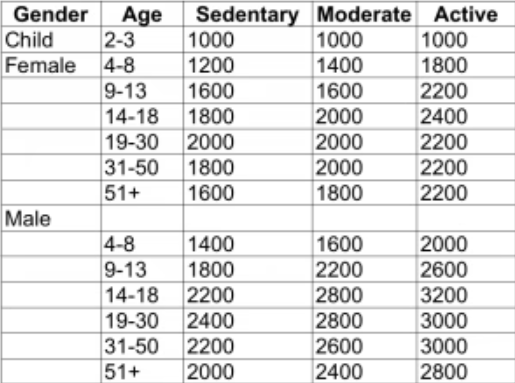
    Calorie requirements are highly individualized. An ideal daily intake of calories varies depending on age, metabolism and levels of physical activity, among other things. The Dietary Guidelines for Americans provide calorie estimates for men and women based on age and activity level. For example, these guidelines note that the general recommended intake for adult women ranges from 1,600 to 2,400 calories daily, while men often require 2,000 to 3,000 calories a day to maintain healthy body weights.  


    Sedentary people need fewer calories because sitting is not very demanding, and most Americans are quite sedentary. According to a study reported by the American College of Sports Medicine, American adults, ages 20 to 75, reported spending an average of 9.5 hours sedentary each day, and most of this time was accumulated at work and during leisure-time. Then factor in that most of us sleep 7-8 hours per night. 
     
    Harvard Medical School says that sedentary adults require 13 calories for each pound of their body weight on a daily basis. For example, a sedentary 130-pound woman needs about 1,700 calories, while a 175-pound, inactive man requires about 2,300 calories daily to maintain a healthy body weight.
     
    Yet, those numbers are to maintain body weight. If you need to lose weight, you’ll need to lower your caloric intake. The University of Washington suggests that overweight adults need 10 calories per pound of their desirable body weight to move toward that healthier weight. For example, an overweight woman with a goal weight of 130 pounds needs 1,300 calories daily, while an obese man trying to reach 175 pounds needs about 1,750 calories daily to reach his goal.
     
    Again, any caloric reduction should be done slowly and gradually. Give your body — particularly your stomach and brain, which communicate hunger signals — time to adapt. Initially, at least, focus on eating slowly and eating more whole foods, instead of just eating smaller portions. After a week or two of these adjustments, you can begin to focus on portion sizes and limiting caloric intake, which should accelerate your weight loss. Being hungry all the time will cause a backlash and result in bad food choices and, ultimately, overeating. 
     
    Highly-processed foods, aka “junk” foods, are typically loaded with sugar, fat, and sodium. Beyond that, they often harm the microbiome, the delicate balance of microorganisms in the gut, which contributes to various health problems. Highly-processed foods are also associated with increased systemic inflammation. 
     
    If you can gradually shift to to eating more whole, minimally-processed foods more often, you’ll be on the right track. Don’t do it all at once and don’t be militant about it. Slowly cut your calories to a number that suits your sex, age and activity level. 
     
    Don’t restrict food to the point that it causes anxiety or stress. That will prove to be unproductive and will undermine your goals. Simply put, don’t deprive yourself. By eating more slowly, and eating foods that are high in protein and fiber, which are more filling, you can become more attuned to hunger sensations and learn to stop before overeating. 
     
    Lastly find healthier ways to cope with stress that don’t involve eating, such as taking a walk, doing a crossword puzzle, talking to a close friend or loved one, or even meditating. Stress is part of life; don’t let it undermine you. 
     
    Be compassionate with yourself. Be on your own side and don’t be so judgmental. Good things — the fruits of your labor — take time to manifest. Keep moving forward and know that your sustained efforts will pay off. Be patient and remain focused. 

  • The Risks of Excessive Screen Time and ‘Sitting Disease’

    The Risks of Excessive Screen Time and ‘Sitting Disease’

    Always listen to your body. Never ignore the things it’s telling you; it has important information that you need to know and acknowledge. Pay attention to its cues. 
     
    As a 21st Century society, we sit far too much. Beware of so-called “sitting disease,” also known as the “desk sentence.”
     
    Constant sitting decreases your metabolism and is associated with increased risk of diabetes, cardiovascular disease, and cancer.
     
    Sitting disease:
     
    • Impairs your circulation
    • Compresses vital fluids (such as lymphatic fluid) and impacts cell growth
    • Leads to joint stiffness, low back pain, sciatica, hip pain, neck pain, and shoulder pain
     
    Over-eating and obesity are distress signals from your body; don’t ignore them. The health risks from over-eating and obesity are numerous and widely reported. Mindless over-eating is often associated with excessive screen time.
     
    Depriving yourself of sleep leads to cognitive impairment, a less efficient brain, over-eating, higher emotionality, increased anxiety, and delayed production of melatonin (the sleep hormone). Many people are sleep deprived due to an inability to limit screen time.
     
    As of 2020, it is estimated that one-third of the world’s population (2.6 billion) has myopia and that by 2050 it will affect half the global population. This short-sightedness is typically associated with excessive screen time and, in the worst cases, leads to blindness. Think I’m overstating the problem? Well, by 2050 myopia is projected to become the leading cause of permanent blindness worldwide. 
     
    Our inability to unplug and disengage from our digital devices is causing widespread stress, anxiety and self-reported depression. At this point, many people are all too familiar with “Zoom fatigue” and the associated energy loss. Many people feel they have no autonomy to determine when to disconnect. They even wake up at night to check work emails and/or text messages.
     
    This inability to disconnect has led to a lack of work/life balance, and longer work days that are uncompensated. This, in turn, has led to a long term loss of motivation.
     
    The overuse of social media has also led to more radical emotions, such as fear and outrage. It’s even led to lower self-esteem and body image.
     
    People are suffering from digital burnout and it’s little surprise that depression has risen. Researchers in a 2017 study found that adults who watched TV or used a computer for more than 6 hours per day were more likely to experience moderate to severe depression.
     
    The pandemic only made the situation worse.
     
    During the first year of the pandemic, April 2020-April 2021, the prevalence of people with depression or anxiety symptoms in America increased substantially — from about 11 percent of people in 2019 to close to 40 percent.
     
    We leave ourselves little to no time to recover from our digital overload because almost everything in our lives revolves around screen time. Consider all the things that people now do online:
     
    • Shopping
    • School
    • Mail
    • Work
    • Meetings
    • News
    • Arts
    • Sex
    • Movies
    • Bills
    • Chatting
    • Leisure/social media scrolling
     
    Some of these activities amount to using tech to relax from too much tech, which has led to what is called the “digital fatigue paradox.” More engagement simply leads to more stress. This is digital burnout.
     
    Give yourself a digital detox. Set aside time in the day when you check out and stop all screen time; give your eyes and brain a rest. Set a nighttime digital curfew. Turn off your phone at night and keep it off until the next morning. These aren’t novel ideas; this was normal, everyday life prior to the 21st Century.
     
    Take the initiative to get up and move more. A four-year study published in the Annals of Internal Medicine suggest that getting up and moving around every 30 minutes could help you avoid some of the health woes that come with sitting all day.
     
    Just set your phone alarm, Apple Watch or Fitbit to alert yourself to get up and move every 30 minutes (a paradox, huh?). It doesn’t need to be for more than a few minutes, but just the simple act of standing up and moving around will do you a lot of good.
     
    Even if you exercise vigorously on multiple days of the week, taking a daily 30-minute walk has enormous health benefits and can prevent chronic disease as you age. Walking is good for us orthopedically; we are meant to move.
     
    Just the simple act of walking also reduces stress, cheers you up (walking releases endorphins, your body’s happy hormones), and increases self-esteem. You’ll feel better about yourself just for doing it. And, if you leave your phone at home, it forces you to disconnect from screen time.
     
    We have more control over our health destiny than we might realize. We just need to take the wheel and steer.
  • Sleep Is Vital to Good Health, Yet Many of Us Aren’t Getting Enough

    Sleep Is Vital to Good Health, Yet Many of Us Aren’t Getting Enough

    One-third of U.S. adults are struggling to get a good night’s rest, according to a jointly conducted web survey by Gallup and mattress retailer Casper. This suggests that nearly 84 million Americans are not getting adequate sleep.
     
    Moreover, 65% said they were unable to get the recommended seven to nine hours of sleep a night.
     
    This sleep deficit has negative health consequences. Research confirms that not getting the recommended 7-9 hours of sleep per night, or getting poor quality sleep, increases risks for high blood pressure, elevated cholesterol and atherosclerosis, which happens when fatty deposits build up in arteries. Not getting enough sleep is linked to weight gain, diabetes and inflammation, all of which can worsen cardiovascular disease.
     
    The survey of more than 3,000 adults indicated that stress is a major factor in this epidemic of sleepless. If the word epidemic sounds hyperbolic, that’s exactly how the CDC describes it.
     
    Two years of the coronavirus pandemic drove stress levels to extraordinary levels and even as that now begins to wane, new stressors seem to have supplanted it. An American Psychological Association study recently found that Americans are feeling more anxious about inflation, global uncertainty, and the war in Ukraine.
     
    Our emotional and mental states are major contributing factors to how easily we fall asleep and whether we stay asleep all night.
     
    There are strategies you can utilize to help improve your sleep. For example, 30 minutes of daily exercise improves your odds of a great night’s sleep by 30%. That’s because exercise helps work off stress and anxiety. Moving your body and raising your heart rate help ensure a better night’s sleep.
     
    Creating some form of ambient white noise, such as with a fan or noise machine that creates nature sounds, can also be calming, soothing and sleep inducing.
     
    Healthy nutrition, meditation and/or breathing exercises can also be quite helpful. For example, you can count your in-breaths or out-breaths from one to 10. You can then count them backwards from 10 to one. If your mind wanders, bring your attention back to your breathing and start counting from one again. Focused breathing is relaxing in and of itself, but it can also help stop the mind from wandering. If you practice while lying in bed, eventually you’ll fall asleep while counting your breaths.
     
    Another useful strategy is to have a specific bedtime routine that you follow every night. Varying bedtimes and wake times put your body’s internal clock, the circadian clock, out of cycle. Going to bed and getting up at the same time every day, even on weekends, prevents this disruption. Changes in your sleep schedule thwart a natural sleep pattern, which throws off your circadian cycle.
     
    A regular bed time is critical for your health and wellness, as is a regular waking time. Additionally, sleeping too long can affect your ability to fall asleep that night. After a good night’s sleep, most people need to be awake around 16 hours before they feel sleepy again.
     
    Going to sleep between 10:00 pm and 11:00 pm is associated with a lower risk of developing heart disease compared to earlier or later bedtimes, according to a new study by the European Society of Cardiology. Early or late bedtimes may be more likely to disrupt the body’s circadian clock, with adverse consequences for cardiovascular health, according to the study’s authors.
     
    The incidence of cardiovascular disease was highest in those with sleep times at midnight or later (25% higher risk) and lowest in those with sleep onset from 10:00 to 10:59 pm. There was a 24% higher risk for falling asleep before 10:00 pm.
     
    When it gets dark, your brain ramps up its production of melatonin, a hormone that regulates your sleep-wake cycle. Essentially, melatonin helps you fall asleep — and stay asleep. On the other hand, light signals your brain to stop making melatonin, which helps you wake up and feel alert in the morning.
     
    Too much light just before bedtime, especially the blue light from electronic devices, can also disrupt our internal clocks. The brain’s nighttime surge of melatonin is known as melatonin onset. This naturally occurs as the sun sets and your environment literally starts to dim.
     
    However, modern humans no longer live by the sun’s daily cycle. We now have the ability to artificially keep our home environments bright at night. All that light signals to your body that it’s still daytime, which definitely doesn’t help you fall asleep. For this reason, it’s best to turn off screens and other intense lights a half-hour or so before bedtime. Reading by a dim light just before bed is a great way to ready the brain and induce sleep.
     
    Eliminating light in your bedroom is also a key requisite to a good night’s sleep. Even small sources of light, such as from your alarm clock or smoke detector can be disruptive, according to sleep research. There are tiny receptor cells in your retina that look for light intensity. Sleeping in a pitch-black environment helps ensure that those retinal receptors don’t find any light — until you’re ready to wake up in the morning.
     
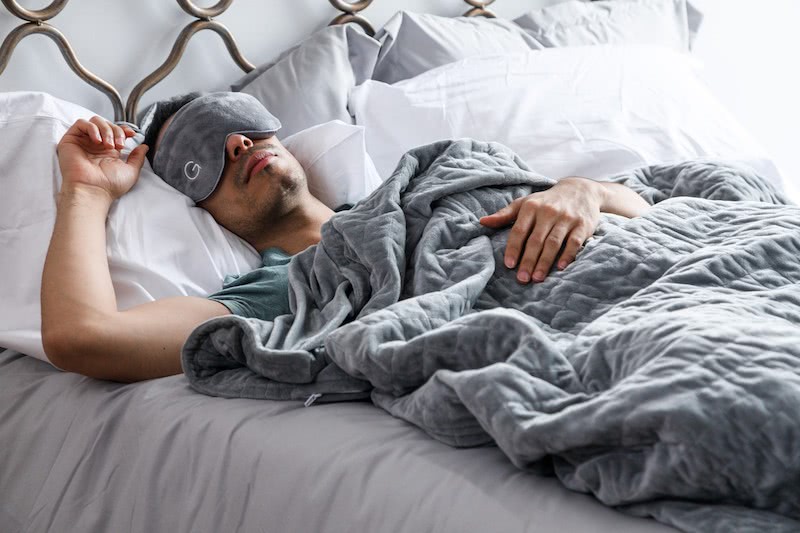
    However, totally blacking out your room, such as with blackout curtains, in order to create a perfect sleep chamber may not be realistic for you. Yet, most of us can wear a sleep mask.
     
    Wearing a sleep mask could actually benefit your health. A small study at Northwestern University found that participants who slept in a dimly lit room had a continuously elevated heart rate. And in the morning, they also had more trouble getting their blood sugar into a normal range, a condition known as insulin resistance.
     
    These physiological changes happened even though their actual sleep wasn’t really disturbed. In fact, the participants generally said they slept fine. Yet, their brains and hearts knew that the lights were on, even though these people were sleeping. Even a relatively small amount of light was enough to shift their nervous systems into a more alert and activated state. The study provides evidence that sleeping with even relatively dim light exposure can be disruptive to our sleep-wake cycle.
     
    The resulting risk of chronic diseases like insulin resistance, diabetes, other cardio-metabolic problems is real. One five-year observational study of more than 40,000 women found that having a light or TV on while sleeping was associated with an increased risk of gaining more than 10 pounds.
     
    Furthermore, research shows that a lack of sleep can:
     
    • Affect cognition, decreasing focus and work productivity
    • Sap your energy and desire to work out
    • Elevate appetite and food cravings
    • Lead to more impulsive decisions, impacting food choices
    • Boost irritability, straining relationships
    • Increase stress levels (which makes sleep more difficult)
     
    In summation, for all these reasons, it’s best to:
     
    • Exercise daily, even if it’s just a walk
    • Create a cool, dark bedroom environment that’s conducive to sleep
    • Prepare for sleep by dimming lights and not using blue-light emitting devices 30 minutes before bed
    • Stop watching news or other distressing content before bed
    • Use breathing exercises when you’re having trouble sleeping
    • Keep specific bed and wake times
    • Wear a sleep mask
     
    Follow these tips, and you’ll enjoy a continually better night’s rest and, ultimately, a better quality of life.
  • Stress Management Key to Life Management

    Stress Management Key to Life Management

    In 2018, Americans ranked among the most stressed people in the world, according to a Gallup Poll. Americans reported feeling stress, anger and worry at the highest levels in a decade, according to the survey.
     
    At the time, about 55 percent of adults said they had experienced stress during “a lot of the day” prior, compared with just 35 percent globally. About 45 percent of the Americans surveyed said they had felt “a lot” of worry the day before, compared with a global average of 39 percent.
     
    Mind you, this was pre-pandemic.
     
    Stress is problematic because it affects all of the body’s organ systems, including the brain and nervous system, the cardiovascular system, the musculoskeletal system, the immune system and the digestive system. Stress can even affect our perceptions, thoughts, beliefs and feelings.
     
    There is mounting evidence that chronic stimulation of the sympathetic nervous system can lead to long-term physiological dis-regulation, resulting in problems such as increased blood pressure, cardiac arrhythmias, digestive problems, chronic headaches, back aches and sleep disorders, as well as psychological disorders such as chronic anxiety, depression or both.
     
    While stress is often unhealthy, we often habitually and automatically react to it in ways that are also unhealthy.
     
    About 38 percent of adults in 2017 battled an illicit drug use disorder, according to the National Survey on Drug Use and Health, which is stunning.
     
    This included use of illegal drugs, prescription drugs, alcohol and tobacco, and the misuse of prescription drugs.
     
    Food is often used to cope with stress and emotional discomfort. Many people eat whenever they feel anxious or depressed. Food is often used as a means to fill an emptiness inside. Foods high in fat and sugar, the so-called comfort foods, are most commonly used to deliver stress relief.
     
    Yet, there are other unhealthy strategies that people utilize to cope with stress. One is to simply deny that there is any problem at all. Another is workaholism; if one feels stressed by family life, working provides an excuse to not be at home.
     
    These are all examples of maladaptive coping attempts; while they may give some relief in the short run, they can compound stress in the long run. They don’t ultimately make us healthier or happier. Your body can tell you some important things, if you’re willing to listen to it rather than tuning out.
     
    It is not the particular stressor itself but how you perceive it, then how you handle it, that will determine whether or not it will lead to stress. Your perception and how you handle the stressor makes all the difference in how much stress you will experience. If we can change the way we see, we can change the way we respond, thereby significantly lowering our stress, as well as its short- and long-term consequences for our health and wellbeing.
     
    In the end, we are well-advised to stop reacting to stress and to instead start responding to it. Responding to stress with greater mindfulness instead of reacting to it habitually and automatically can dramatically reduce the negative effects of stress.
     
    We can become more resistant to stress, more resilient, if we build up our resources and enhance our physical and psychological wellbeing via meditation, regular exercise, adequate sleep, and a sense of deep connectedness with others, to name four of the most important.
     
    This bears repeating. Healthy coping strategies include: meditating, exercising regularly, practicing yoga, praying, sharing your feelings with close friends, and having hobbies or interests that take your mind off your troubles. People who do these things tend to be stress hardy.
     
    Having a healthy strategy to manage pressure or stress can reduce our dependence on the common maladaptive coping strategies that we so often resort to, and get stuck in, when we feel tense.
     
    Greater resilience in the face of stressors and reduced stress reactivity are characteristic of people who practice meditation regularly. This has been demonstrated in a large number of studies.
     
    This is why I practice meditation daily, and why I teach it to others. If you’re interested in beginning a meditation practice, reach out and let me know. I have many years of experience and can help you get started.
  • Diet vs Nutrition

    Diet vs Nutrition

    While many people continually “go on a diet” (and then another and another), everyone has a diet. I’ve never gone on a diet, but I’ve always had a diet. As I always say, diet should be viewed as a noun, not a verb. It’s a thing you have, not an action you take. Every action has a reaction (intended or otherwise), so any diet plan you initiate can quickly be halted in favor of something else.
     
    If you instead think of your diet as part of your lifestyle, you’re much more likely to stick to it. 
     
    Everyone has a diet, but not everyone gets good nutrition. In the minds of many people, low-calorie means healthy. Yet, this isn’t necessarily true.
     
    For example, a rice cake has just 35 calories. Yet, it is almost entirely devoid of fiber and protein. Though a rice cake has very few calories, it also has very little nutrition, not to mention that it’s entirely processed.
     
    On the other hand, an avocado, which grows on a tree, is both calorically and nutritionally dense. An avocado can weigh anywhere from 8 ounces to 3 pounds (48 ounces). So, serving size matters.
     
    One cup (8oz) of sliced avocado has 234 calories and 21 grams of fat, most of which is monounsaturated. It is packed with fiber (10g) and potassium (more than a banana), and is also a great source of vitamin-C, folate and B-6. Additionally, it has virtually no sugar (despite being a fruit) and very few carbs (for those who care about such things).
     
    In short, an avocado is loaded with healthy fats, fiber and various important nutrients.
     
    Yet, some people would choose a nutritionally lacking rice cake over an avocado simply because it is lower in calories. Bad move. Caloric content and nutritional content are not necessarily related. 
     
    No one thinks of a Big Mac as health food. Yet, you could eat three Big Macs a day and still lose weight. Don’t believe me? Well, a Big Mac has just 550 calories. Eat three a day and you’d ingest just 1,650 calories. Since the average American now eats a whopping 3,660 calories per day, eating one Big Mac for breakfast, lunch and dinner would cut that average intake by more than half. Do that, and watch the pounds melt away!
     
    However, you’d be missing lots of important nutrition on the Big Mac Diet. McDonald’s signature sandwich has minimal calcium, potassium and fiber, and zero vitamin D. However, it is loaded with sodium (44% of the daily value) and has 11 grams of saturated fat (53% of the daily value). Eat three a day and you’d be ingesting an enormous amount of salt and unhealthy fat.
     
    Oh, and one Big Mac also has nine grams of sugar. Eat three of them and you’d intake 27 grams of sugar, which is above the 24-gram daily limit recommended for women by the American Heart Association.
     
    Yet, on this Big Mac Diet you’d lose weight, and that would ultimately have a positive effect on your health. Scientific evidence shows that losing just 10 pounds can decrease hypertension, improve good cholesterol (HDL), lower triglycerides, decrease insulin resistance, reduce inflammation in blood vessels, improve or reverse sleep apnea, and increase energy and vitality.
     
    That said, there are better, healthier ways to lose weight than the Big Mac Diet. 
     
    The point is that calories and nutrition are not synonymous. You can eat a low-calorie diet that is not healthy. More to the point, you can eat a low-calorie diet and not necessarily be healthy.
     
    On the other hand, you can eat a very healthy diet featuring high-calorie foods that are packed with nutrition (i.e., avocados, nuts, nut-butters, salmon, whole-fat yogurt, etc.). Additionally, high-calorie foods are more filling than most low-calorie foods (like rice cakes), meaning you might ultimately eat less.
     
    Low calorie foods are not necessarily nutritious, beneficial or preferable. And high-calorie foods are not necessarily unhealthy or to be avoided. The goal should be to maximize nutrition at each and every meal, even if you also seek to limit calories.
     
    If you need to lose weight to be more healthy, you can do this by eating healthy, whole foods, such as fruits, vegetables, a wide variety of animal- and/or plant-based proteins, plus whole grains (There’s more than just wheat, people! Try spelt, millet, amaranth, quinoa, black or red rice, whole oats, etc.).
     
    And, yes, you can indeed lose weight by including healthy, high-calorie foods in your diet. You just need to limit your total caloric intake. To do that, you need to track your daily caloric input. And you should also know how many calories you need each day.
     
    As the Twinkie Diet proved, you can eat an unhealthy diet and still lose weight. The Big Mac Diet would be no different.
     
    By the same token, you can have a healthy diet and still gain weight, if your caloric intake is higher than your needs.
     
    To lose weight, it comes down to quality and quantity. You should aim for higher quality foods, and a lower quantity of them, each day.
  • Good Habits Can Have a Domino Effect

    Good Habits Can Have a Domino Effect

    We all have various reasons that we work out, assuming we do so at all. For some, it’s to relieve stress and anxiety. Some may feel a great sense of pride and accomplishment afterwards. For others, working out may be a vanity project that provides a sense of confidence and the ability to fit into tight jeans or proudly wear a tank top or a backless dress.
     
    Yet, health outcomes, not simply appearance, should be your main motivation. It’s well established that the health benefits of exercise go beyond the physical. Once you make exercise part of your routine, you may notice a host of psychological benefits, such as feeling more energized, less stressed, and sleeping better.
     
    As you begin to notice how much better exercise makes you feel, the more you’ll want to do it regularly. At that point, exercise becomes a habit. What’s most important is to perform the activities you really enjoy, which will help you adhere to your program.
     
    It’s said that old habits are hard to break and new habits are hard to form. This is especially true with exercise. If you’re not in the habit of exercising, remaining physically inactive is effortless. To create the habit of exercising, however, takes a lot of resolve, determination and effort.
     
    The more consistent an action is, the more likely it is to become a habit. This means that exercising every day is more likely to result in habit formation. One useful idea is to schedule your exercise for a given time each day, as you would with a personal trainer. Accountability is critical to maintaining your schedule and forming a habit.
     
    As Charles Duhigg, author of The Power of Habit notes, “When people start habitually exercising, even just once per week, they start changing other, unrelated patterns in their lives, often unknowingly. They often start eating better, becoming more productive, smoking less and feeling less stressed. It’s not completely clear why. But, for many people, exercise is a keystone habit that triggers widespread, positive change.”
     
    Researchers asked some study participants to write down what they ate once a week. This keystone habit, food journaling, created a structure that helped other habits to flourish. Six months into the study, these participants had lost twice as much weight as the other study participants.
     
    Unfortunately, 42 percent of Americans are obese, according to the CDC, and another 30 percent or so qualify as overweight. So, roughly three-quarters of our population has an unhealthy bodyweight. Because of this, many people view exercise solely as a means of weight loss. But there’s a whole lot more to it than that. The mental and emotional components of exercise cannot be emphasized enough.
     
    Exercise has been shown to increase grey matter in the brain, according to research published by the Mayo Clinic. Exercise also promotes brain plasticity by stimulating the growth of new connections between cells. Consequently, exercise improves cognitive ability and memory. 
     
    Furthermore, exercise releases chemicals, such as endorphins and serotonin, that improve your mood. As noted, exercise not only enhances self-esteem, it also reduces anxiety and depressed mood.
     
    “There’s good epidemiological data to suggest that active people are less depressed than inactive people. And people who were active and stopped tend to be more depressed than those who maintain or initiate an exercise program,” says James Blumenthal, PhD, a clinical psychologist at Duke University.
     
    Yet, there’s no denying the impact that exercise can have on our physical health and our ability to function well, aka, perform our activities of daily living.
     
    Don’t wait until your doctor tells you to exercise! At that point, too much time will have been lost.
     
    More than 1-in-3 adults, about 92.1 million people, have at least one type of cardiovascular disease, which is preventable.
     
    In fact, many forms of chronic illness are preventable. According to the CDC, the health-risk behaviors we can change include: lack of exercise/physical activity, poor nutrition, tobacco use and excessive alcohol use. These four behaviors cause much of the illness, suffering and early death related to chronic diseases and conditions. In essence, they are bad habits that can be corrected.
     
    It’s important to remember that health is not just about food and exercise. Everyone would benefit from things such as meditation, learning a new skill, developing a new hobby, and/or growing your social network. Each of these things can make you a healthier person in measurable ways. 
     
    If you’re new to exercise or haven’t done it in a long time, start slowly. Don’t take the attitude that you can get fit today or even this week. Allow your body time to adjust to the demands you’re placing on it. Your exercise routine should be progressive, growing in either intensity or duration as your fitness level gradually improves.
     
    The physical effects of exercise — such as weight loss, lower blood pressure or a lower resting heart rate — take time and patience; you may not see your numbers move for weeks to months.
     
    The mood boost from exercise, however, is often immediate, offering near-instant gratification. Alleviating mood disorders, such as anxiety or depression, may take longer, but the mental and emotional effects of exercise are often immediately tangible.
     
    The most important takeaway is that good habits can have a domino effect, with one healthy change leading to another and so on. After committing to a few healthy acts, we’re less likely to back-step and commit unhealthy acts. After all, no one wants to undermine their own progress.
     
    Start with the easiest change you can think of; pick the low hanging fruit first. Once you’ve created a healthy daily habit that lasts a couple of weeks, add another easy-to-achieve step. View these changes as rungs on a ladder; take them one step at a time. Be consistent and be progressive. But don’t take on too much, too soon. 
     
    Small victories lead to a sense of pride, achievement and accomplishment. These are all empowering and rewarding feelings. Ultimately, one good change will lead to another.