Tag: calories

  • Stress Can Undermine Weight Loss and Increase Weight Gain

    Stress Can Undermine Weight Loss and Increase Weight Gain

    If you’re a stress eater (i.e., you eat to cope with stress), restricting calories can cause even more stress.

    If you eat a little less than your body needs, it can help you lose weight and body fat without sacrificing performance or wellbeing.

    However, eating a lot less, especially for a long time, and especially when you have major recovery needs—like hard athletic training or recovering from surgery—can actually thwart proper recovery. It can even cause your body to turn down the thermostat, restricting calorie burning. In essence, your body goes into preservation mode.

    Food is meant to nourish the body and the right amounts are vital to athletes. An excessive or chronic caloric deficit can impair performance, decrease lean muscle mass, and lead to a host of other issues ranging from hormonal imbalances to immune deficiencies.

    You need to eat enough to support your physiological needs. Unfortunately, most Americans (truly, the majority) eat well beyond their physiological needs. Stress is a common culprit.

    Cutting too many calories all at once can be very stressful and leave a person feeling like they’re starving. That’s not a formula for successful weight loss or athletic performance.

    It’s best to taper slowly, gradually reducing your caloric intake. Say, for example, that you (or your coach or nutritionist) determine that you should be eating 2,000 calories per day (I chose this because it’s a round number that’s easy to work with). Let’s also say that you discover, through the use of a food app, that you’re actually eating about 2,600 calories per day, which is why you’re overweight. 

    You’re best off tapering to 2,400 calories for about two weeks, and then dropping down 2,200 for another two weeks before finally settling in at your proper intake of 2,000 calories per day. This gradual step-down will keep your body from going into starvation mode and keep you from feeling hungry all the time, which will undermine your efforts. 
     
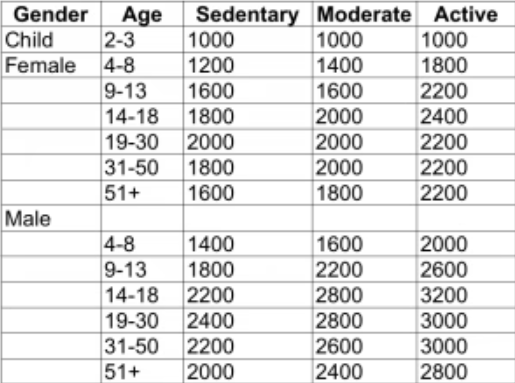
    Calorie requirements are highly individualized. An ideal daily intake of calories varies depending on age, metabolism and levels of physical activity, among other things. The Dietary Guidelines for Americans provide calorie estimates for men and women based on age and activity level. For example, these guidelines note that the general recommended intake for adult women ranges from 1,600 to 2,400 calories daily, while men often require 2,000 to 3,000 calories a day to maintain healthy body weights.  


    Sedentary people need fewer calories because sitting is not very demanding, and most Americans are quite sedentary. According to a study reported by the American College of Sports Medicine, American adults, ages 20 to 75, reported spending an average of 9.5 hours sedentary each day, and most of this time was accumulated at work and during leisure-time. Then factor in that most of us sleep 7-8 hours per night. 
     
    Harvard Medical School says that sedentary adults require 13 calories for each pound of their body weight on a daily basis. For example, a sedentary 130-pound woman needs about 1,700 calories, while a 175-pound, inactive man requires about 2,300 calories daily to maintain a healthy body weight.
     
    Yet, those numbers are to maintain body weight. If you need to lose weight, you’ll need to lower your caloric intake. The University of Washington suggests that overweight adults need 10 calories per pound of their desirable body weight to move toward that healthier weight. For example, an overweight woman with a goal weight of 130 pounds needs 1,300 calories daily, while an obese man trying to reach 175 pounds needs about 1,750 calories daily to reach his goal.
     
    Again, any caloric reduction should be done slowly and gradually. Give your body — particularly your stomach and brain, which communicate hunger signals — time to adapt. Initially, at least, focus on eating slowly and eating more whole foods, instead of just eating smaller portions. After a week or two of these adjustments, you can begin to focus on portion sizes and limiting caloric intake, which should accelerate your weight loss. Being hungry all the time will cause a backlash and result in bad food choices and, ultimately, overeating. 
     
    Highly-processed foods, aka “junk” foods, are typically loaded with sugar, fat, and sodium. Beyond that, they often harm the microbiome, the delicate balance of microorganisms in the gut, which contributes to various health problems. Highly-processed foods are also associated with increased systemic inflammation. 
     
    If you can gradually shift to to eating more whole, minimally-processed foods more often, you’ll be on the right track. Don’t do it all at once and don’t be militant about it. Slowly cut your calories to a number that suits your sex, age and activity level. 
     
    Don’t restrict food to the point that it causes anxiety or stress. That will prove to be unproductive and will undermine your goals. Simply put, don’t deprive yourself. By eating more slowly, and eating foods that are high in protein and fiber, which are more filling, you can become more attuned to hunger sensations and learn to stop before overeating. 
     
    Lastly find healthier ways to cope with stress that don’t involve eating, such as taking a walk, doing a crossword puzzle, talking to a close friend or loved one, or even meditating. Stress is part of life; don’t let it undermine you. 
     
    Be compassionate with yourself. Be on your own side and don’t be so judgmental. Good things — the fruits of your labor — take time to manifest. Keep moving forward and know that your sustained efforts will pay off. Be patient and remain focused. 

  • Sugar: The Biggest Dietary Threat to Your Health

    Sugar: The Biggest Dietary Threat to Your Health

    For decades, Americans were warned to reduce their fat and cholesterol intake in order to prevent heart disease, the nation’s No. 1 killer of both men and women. However, it is now known that sugar is the greater threat to our national health.
     
    The link between sugar and heart disease was purposefully obscured for decades. In 1964, after studies began linking sugar with heart disease, the Sugar Association (a sugar industry trade group) began funding research that cast doubt on sugar’s role in heart disease, in part by pointing the finger at fat.
     
    First, we should note the difference between naturally occurring sugar and added sugar, which is the real threat.
     
    Sugar occurs naturally in all foods that contain carbohydrates, such as fruits and vegetables, grains and dairy. Consuming whole foods that contain naturally occurring sugar is okay. Plant foods also have high amounts of fiber, essential vitamins, minerals and antioxidants, and dairy foods contain protein and calcium.
     
    Since your body digests these foods slowly, the sugar in them offers a steady supply of energy to your cells. A high intake of fruits, vegetables, and whole grains also has been shown to reduce the risk of chronic diseases, such as diabetes, heart disease, and some cancers.
     
    However, problems occur when you consume too much added sugar — that is, the sugar food manufacturers add to their products to increase flavor and/or extend shelf life. The added sugar in our food is generally regular table sugar (sucrose) and high-fructose corn syrup (a mix of fructose and glucose).
     
    Remarkably, sugar is the most popular ingredient added to foods in the US. In fact, about 80% of all sugar found in US foods has been added by the food industry. The top sources of sugar in the American diet are soft drinks, fruit drinks, flavored yogurts, cereals, cookies, cakes, candy, and other processed foods. 
     
    Yet, added sugar is also present in items you may not think of as sweetened, such as soups, cured meats, and ketchup. Yes, sugar isn’t merely found in sweets; it’s also added to many other processed foods, such as crackers, breads, peanut butter, and salad dressings. In fact, most processed foods contain sugar.
     
    While you might not think you’re eating much sugar, chances are you’re eating a lot more than you realize. Added sugar lurks in nearly 70% of packaged foods and is found in many sauces, snacks, most breakfast foods, and even many so-called ‘health foods’.
     
    The result: we consume way too much added sugar.
     
    Today, the average American consumes 66 pounds of added sugar each year, according to government data. That’s more than one pound of sugar each week!
     
    This is of great concern since too much added sugar is among the greatest threats to cardiovascular disease. Eating and drinking too many added sugars can also contribute to other health problems, such as type-2 diabetes and obesity. 
     
    “Sugar is actually more addictive than even cocaine, so it is probably the most consumed addictive substance around the world and it is wreaking havoc on our health,” says cardiovascular researcher James DiNicolantonio.
     
    Sugar’s impact on heart health has long been researched by Dr. Frank Hu, professor of nutrition at the Harvard T.H. Chan School of Public Health.
     
    In a study published in 2014 in JAMA Internal Medicine, Dr. Hu and his colleagues found an association between a high-sugar diet and a greater risk of dying from heart disease. Over the course of the 15-year study, people who got 17% to 21% of their calories from added sugar had a 38% higher risk of dying from cardiovascular disease compared with those who consumed 8% of their calories as added sugar.
     
    “Basically, the higher the intake of added sugar, the higher the risk for heart disease,” says Dr. Hu.
     
    High amounts of sugar overload the liver, potentially leading to fatty liver disease, a contributor to diabetes, which also raises your risk for heart disease.
     
    Consuming too much added sugar can also raise blood pressure and increase chronic inflammation, both of which are pathological pathways to heart disease.
     
    “The effects of added sugar intake — higher blood pressure, inflammation, weight gain, diabetes, and fatty liver disease — are all linked to an increased risk for heart attack and stroke,” says Dr. Hu.
     
    Diabetes has reached epidemic proportions in the US. It kills more Americans each year than AIDS and breast cancer combined, according to the American Diabetes Association.
     
    More than 100 million US adults are now living with diabetes or pre-diabetes, according to a 2017 CDC report. Pre-diabetes is a condition that, if not treated, often leads to type-2 diabetes within five years. Despite the fact that more than a third of US adults have pre-diabetes, the majority don’t know it, says the CDC.
     
    Even a relatively small amount of sugar can do a lot of damage to your health. People who add 150 calories of sugar to their daily diet — from sources such as a 12-ounce can of Coke or an ounce of M&Ms — have 10 times greater risk of developing diabetes.
     
    Additionally, people who consume a diet high in fructose risk damaging their immune systems, a new study suggests. The study shows that fructose, which is commonly found in sugary drinks, sweets and processed foods, causes the immune system to become inflamed.
     
    Furthermore, researchers say that consuming too much added sugar (as well as artificial sweetener, fast foods, fried foods, processed foods, and alcohol) can harm your gut microbiome.
     
    The American Heart Association (AHA) has long suggested that men consume no more than nine teaspoons (36 grams) of added sugar per day. That’s close to the amount in a 12-ounce can of soda. Women are advised to limit added sugars to no more than six teaspoons a day (24 grams).
     
    However, the average American still eats about 17 teaspoons (19 for men, 15 for women) of added sugar a day, according to the CDC. That’s about double the recommended limit for men (nine teaspoons) and two-and-a-half times the limit for women (six teaspoons). This doesn’t include the sugars that occur naturally in foods like fruit or dairy products.
     
    In other words, American adults consume an average of 77 grams of added sugar per day. Again, that’s more than two times the recommended amount for men and two-and-a-half times the recommended amount for women. 
     
    Recognizing the problem, the AHA now recommends that sugar intake be limited to less than 6% of daily calories, and the Dietary Guidelines Advisory Committee agrees.
     
    Yet, roughly 90% of Americans still get more than 10% of daily calories from sugar, and the top 10% of sugar-consumers ingest a whopping 40% of their calories from sugar!
     
    Beverages are the leading source of added sugars, accounting for 47% of the total. Examples of sugary beverages include regular soda, fruit drinks, sports drinks, energy drinks, sweetened waters, and coffee and tea beverages with added sugars.
     
    The US ranks third in the world in sales of sugary drinks. In 2013, the average American drank just over 38 gallons of soda a year — or about eight 12-ounce cans a week. 
     
    Reading food labels is one of the best ways to monitor your intake of added sugar. Total sugar, which includes added sugar, is often listed in grams. Note the number of grams of sugar per serving as well as the total number of servings. The package might only say 5 grams of sugar per serving, but if the normal amount is three or four servings, you can easily consume 20 grams of sugar. That’s a lot of added sugar.
     
    By simply being more aware, you can substantially reduce the amount of added sugar in your diet. It would certainly be worth your while.
  • Diet vs Nutrition

    Diet vs Nutrition

    While many people continually “go on a diet” (and then another and another), everyone has a diet. I’ve never gone on a diet, but I’ve always had a diet. As I always say, diet should be viewed as a noun, not a verb. It’s a thing you have, not an action you take. Every action has a reaction (intended or otherwise), so any diet plan you initiate can quickly be halted in favor of something else.
     
    If you instead think of your diet as part of your lifestyle, you’re much more likely to stick to it. 
     
    Everyone has a diet, but not everyone gets good nutrition. In the minds of many people, low-calorie means healthy. Yet, this isn’t necessarily true.
     
    For example, a rice cake has just 35 calories. Yet, it is almost entirely devoid of fiber and protein. Though a rice cake has very few calories, it also has very little nutrition, not to mention that it’s entirely processed.
     
    On the other hand, an avocado, which grows on a tree, is both calorically and nutritionally dense. An avocado can weigh anywhere from 8 ounces to 3 pounds (48 ounces). So, serving size matters.
     
    One cup (8oz) of sliced avocado has 234 calories and 21 grams of fat, most of which is monounsaturated. It is packed with fiber (10g) and potassium (more than a banana), and is also a great source of vitamin-C, folate and B-6. Additionally, it has virtually no sugar (despite being a fruit) and very few carbs (for those who care about such things).
     
    In short, an avocado is loaded with healthy fats, fiber and various important nutrients.
     
    Yet, some people would choose a nutritionally lacking rice cake over an avocado simply because it is lower in calories. Bad move. Caloric content and nutritional content are not necessarily related. 
     
    No one thinks of a Big Mac as health food. Yet, you could eat three Big Macs a day and still lose weight. Don’t believe me? Well, a Big Mac has just 550 calories. Eat three a day and you’d ingest just 1,650 calories. Since the average American now eats a whopping 3,660 calories per day, eating one Big Mac for breakfast, lunch and dinner would cut that average intake by more than half. Do that, and watch the pounds melt away!
     
    However, you’d be missing lots of important nutrition on the Big Mac Diet. McDonald’s signature sandwich has minimal calcium, potassium and fiber, and zero vitamin D. However, it is loaded with sodium (44% of the daily value) and has 11 grams of saturated fat (53% of the daily value). Eat three a day and you’d be ingesting an enormous amount of salt and unhealthy fat.
     
    Oh, and one Big Mac also has nine grams of sugar. Eat three of them and you’d intake 27 grams of sugar, which is above the 24-gram daily limit recommended for women by the American Heart Association.
     
    Yet, on this Big Mac Diet you’d lose weight, and that would ultimately have a positive effect on your health. Scientific evidence shows that losing just 10 pounds can decrease hypertension, improve good cholesterol (HDL), lower triglycerides, decrease insulin resistance, reduce inflammation in blood vessels, improve or reverse sleep apnea, and increase energy and vitality.
     
    That said, there are better, healthier ways to lose weight than the Big Mac Diet. 
     
    The point is that calories and nutrition are not synonymous. You can eat a low-calorie diet that is not healthy. More to the point, you can eat a low-calorie diet and not necessarily be healthy.
     
    On the other hand, you can eat a very healthy diet featuring high-calorie foods that are packed with nutrition (i.e., avocados, nuts, nut-butters, salmon, whole-fat yogurt, etc.). Additionally, high-calorie foods are more filling than most low-calorie foods (like rice cakes), meaning you might ultimately eat less.
     
    Low calorie foods are not necessarily nutritious, beneficial or preferable. And high-calorie foods are not necessarily unhealthy or to be avoided. The goal should be to maximize nutrition at each and every meal, even if you also seek to limit calories.
     
    If you need to lose weight to be more healthy, you can do this by eating healthy, whole foods, such as fruits, vegetables, a wide variety of animal- and/or plant-based proteins, plus whole grains (There’s more than just wheat, people! Try spelt, millet, amaranth, quinoa, black or red rice, whole oats, etc.).
     
    And, yes, you can indeed lose weight by including healthy, high-calorie foods in your diet. You just need to limit your total caloric intake. To do that, you need to track your daily caloric input. And you should also know how many calories you need each day.
     
    As the Twinkie Diet proved, you can eat an unhealthy diet and still lose weight. The Big Mac Diet would be no different.
     
    By the same token, you can have a healthy diet and still gain weight, if your caloric intake is higher than your needs.
     
    To lose weight, it comes down to quality and quantity. You should aim for higher quality foods, and a lower quantity of them, each day.
  • How Your BMR and RMR Contribute to Your Weight Status

    How Your BMR and RMR Contribute to Your Weight Status

    If you’ve ever weighed yourself before bed at night and again in the morning, you may have been surprised that you lost anywhere from 1-3 pounds. This is fairly normal. We all lose weight at night while sleeping.
     
    How much we lose overnight depends on whether we get enough sleep, how much water we excrete, and our basal metabolic rate (BMR), which is largely determined by the amount of muscle we have (muscle is quite metabolically active).
     
    The body is in an entirely aerobic state while we’re sleeping, since it uses only fat to operate in such a low-energy state (carbohydrates are used only for higher energy demands). Our heart, brain and other organs all need energy to maintain basic functions while we’re sleeping.
     
    In one hour of sleep, most people burn 0.4 to 0.5 calorie for every pound of body weight. For example, a 150-pound person would multiply 150 by 0.4 or 0.5 to get 60 to 75 calories used in one hour of sleep. After eight hours of sleep, that person has burned 480 to 500 calories.
     
    A 200-pound person would burn 80-100 calories per hour, or 640-800 calories during eight hours of sleep.
     
    This may seem unbelievable, but it’s true. You’re burning calories all day long — even while sleeping — just to stay alive; that’s your BMR. Additionally, energy is also expended by digesting your food and from non-exercise daily movements, such as brushing your teeth, getting dressed and pouring your morning coffee. This additional expenditure is known as your resting metabolic rate (RMR).
     
    For American women, the average BMR is 1,493 calories. For American men, the average BMR is 1,662 calories.
     
    Your BMR accounts for about 70 percent of the calories you burn every day (in general, men have a higher BMR than women). This is critically important since there is no way we can exercise away all the calories we consume each day.
     
    Muscle is the single most important predictor of how well you metabolize your food, burn calories, and burn body fat. However, beginning in our late 20s, we start losing muscle, which means our metabolism also starts declining. A consistent weight training program can stop this decline and even reverse it.
     
    There are approximately 3,500 calories in a pound of stored body fat. If you subtract 3,500 calories each week through diet, exercise or a combination of both, you will lose one pound of body weight.
     
    On average, 75 percent of this is fat and 25 percent is lean tissue, which is why it’s so important to strength train while attempting to lose weight; you don’t want to lose your precious muscle along with that unwanted fat. Muscles at rest burn three times more calories than fat, so maintaining or increasing muscle mass influences BMR.
     
    In simple terms, if you’re seeking to lose weight, aim for a 500-calorie deficit each day of the week (7 x 500 = 3,500).
     
    As a guide, the American College of Sports Medicine (ACSM) recommends that women never drop their calorie-intake level below 1,200 per day and men should not go below 1,800 calories per day.
     
    So, back to where we started: it’s possible for a 150-pound person to lose about 1 pound each week simply by sleeping eight hours every night. Remember, a person of this weight burns roughly 500 calories while sleeping each night. Sleep is very valuable!  In fact, sleep deprivation has been linked to an increase in weight.
     
    Clearly, much of this 1-pound of weight loss is water, not just fat (we lose water gradually each night through respiration and perspiration), but burning 500 calories overnight while sleeping is no small matter.
     
    The average person eliminates about 1.2 liters of water in urine each day, and also eliminates about 1 liter a day through perspiration and respiration. That’s 2.2 kilograms (almost 5 pounds) of weight fluctuation happening throughout the day.
     
    So, don’t get caught up in the daily fluctuations of your body weight. You can gain up to 5 pounds during the day just from your food and beverage intake — but it’s not all fat!
     
    Your BMR, non-exercise daily movements, and your daily exercise routine should allow you to at least maintain your present weight. To lose weight, however, you’ll have to reduce your daily caloric intake.
     
    You weigh less in the morning than during the rest of the day because you don’t (normally, at least) eat and drink during the night. Remember that two cups of water (16 ounces or one pint) weighs one pound, so drinking a tall glass of water will temporarily be reflected in your weight.
     
    The most accurate time to weigh yourself is first thing in the morning, when you have an empty stomach. Weighing yourself while naked will also give you a more accurate reflection of your weight. 
     
    Lastly, always weigh yourself on the same scale. Even if it’s off by a pound or so, it will be relative to itself and still reveal any upward or downward movements. Different scales may give you different results, which can be misleading or even maddening.
  • The Benefits of Intermittent Fasting

    The Benefits of Intermittent Fasting

    A lack of sleep may be a big contributor to America’s considerable weight problem.
     
    The National Sleep Foundation (NSF) recommends 7-9 hours of sleep each night for adults, ages 18-64. Yet, more than a third of American adults are not getting enough sleep on a regular basis, according to a CDC study.
     
    Sleeping less than seven hours per day is associated with an increased risk of developing chronic conditions such as obesity, diabetes, high blood pressure, heart disease, stroke and frequent mental distress, according to the CDC.
     
    The hunger hormones leptin and ghrelin have gotten a lot of attention in recent years. Though you may have heard of them, you may not be familiar with their functions.
     
    Think of the ‘l’ in leptin standing for lose. Leptin suppresses appetite and therefore contributes to weight loss. Think of the ‘g’ in ghrelin standing for gain. Ghrelin is a fast-acting hormone that increases hunger and leads to weight gain.
     
    When you’re sleep deprived, research shows, ghrelin levels surge while leptin plummets. The result is an increase in hunger.
     
    The key to reducing your nighttime cravings is to get more sleep; 7-9 hours.
     
    Another key to successful weight loss technique is intermittent fasting or time-restricted eating.
     
    Recent research shows the benefits of intermittent fasting, and those who have tried it often view it as a sustainable, long-term solution.
     
    In the simplest form, intermittent fasting would amount to 12 hours on and 12 hours off. For example, food can be eaten only between 7am and 7pm or 8am and 8pm.
     
    However, research shows that the sweet spot seems to be 10 hours on and 14 hours off. For example, eating only from 9am to 7pm, and then fasting until 9am the next day.
     
    Some intermittent-fasting proponents use only an eight-hour feeding window, with 16 hours of continual fasting each day. For example, eating meals between 12pm and 8pm each day, and fasting at all other times.
     
    This helps to thwart any late-night snacking habits.
     
    The benefit of time-restricted eating is that it allows you to naturally reduce your food intake without counting calories. That’s preferable to most people.
     
    Ultimately, intermittent fasting is about the “when” of eating, not the “what” or “how much.”
     
    Some researchers believe that the rise of later nighttime eating may have thrown off our evolutionary circadian rhythm, the 24-hour cycle that governs the physiological processes of humans and most other living beings, which may be contributing significantly to increases in obesity.
     
    Some studies suggest that by honoring the circadian rhythm and restricting feeding primarily to the daylight hours, we can improve our health and prevent disease.
     
    Fasting allows us to eat in harmony with our circadian rhythm. Circadian rhythms — which determine the sleeping and feeding patterns of all animals, including humans — can be modulated by external cues, such as sunlight.
     
    However, living in the 21st Century has disrupted our circadian rhythms. There is so much artificial light at night that the mind can confuse it with daytime. We also spend an exceptional amount of time (up to 12 hours a day) in front of screens (TVs, computers, tablets and smart phones) that emit blue light, which stimulates the retinal nerves and brain.
     
    21st Century adults spend, on average, 87%-93% of our 24-hours indoors and less than 5% of hours outdoors during the day. This light-dark rhythm disruption leads to less daytime alertness, and promotes depression (especially in older adults) and ADHD.
     
    This has resulted in circadian misalignment, in which our central and peripheral clocks are out of synch. Examples: too much light at night, sleep during daytime and food intake at night.
     
    Time-restricted feeding (12-16 hours of non-feeding) has proven to be the best match to our circadian clocks. The key is to eliminating nocturnal eating. The health benefits of time-restricted feeding double every extra hour of non-feeding time beyond 12 hours, up to 16 hours.
     
    While it is certainly wise to eat a variety of whole foods with high-quality sources of protein, fat and carbohydrate, timing may be the most crucial element when it comes to our eating habits.
     
    Another key is mindfulness. Being a more conscious (mindful) eater also helps you make healthier decisions during your eating window each day, so that you have adequate protein, fiber and water in your diet.
     
    In one study (by Dr. Satchidananda Panda, PhD), participants who adjusted their feeding time from their typical 14–15 hours down to 10 hours not only shed an average of 4% of their body weight, but also reported significantly improved energy levels and more satisfying sleep. Most remarkably, they ate their normal foods and didn’t change their exercise habits.
     
    Choosing to commit to intermittent fasting is easier if you do it with your partner/spouse or family. Any lifestyle change made in conjuncture with someone you live with can make a big difference. It creates a support system and can help keep you accountable.
     
    At the least, focus on getting 7-9 hours of sleep each night and eliminate nighttime snacking. However, you may want to try intermittent fasting / time-restricted eating for about a month to see how it works for you.
     
    It’s not very challenging. I do it and it’s made a difference for me. In fact, I highly recommend it.
  • Beware the Liquid Calories

    Beware the Liquid Calories

    Whether you are trying to lose weight or just maintain it, it’s a good idea to limit your intake of liquid calories. Most Americans only count the calories they get from solid foods, and many are unaware of how liquid calories are sneaking into their diet and affecting their body weight.
     
    A study commissioned by the Milk Processor Education Program found that liquids make up 22 percent of calories in the average American’s diet.
     
    As of 2016, the average American drank about 39 gallons of soda a year—or about eight 12-ounce cans a week—according to the Beverage Marketing Corp.
     
    Yet, soda isn’t the only culprit. Though soda sales have fallen, Americans are still getting lots of unnecessary calories from fruit juice, fruit drinks, sports drinks, energy drinks, sweetened teas and sweetened coffee beverages. In fact, sugar drinks are the single-largest source of calories from added sugar in the American diet.
     
    A typical 12-ounce can of regular cola contains nearly 9 teaspoons of added sugars; a 20-ounce bottle contains 15.5 teaspoons of sugars. Yet, the American Heart Association recommends a maximum daily intake of 6 teaspoons of added sugars for women and 9 teaspoons for men.
     
    Sodas are the perfect example of empty calories. There is virtually no nutrition or useful quality in soda, which is full of unhealthy additives and preservatives, such as artificial colors, phosphoric acid and bicarbonate. This is why cutting back on liquid calories may be more valuable than cutting back on calories from solid food.
     
    Generally speaking, calories from fluids are not satiating and don’t suppress hunger, which means you can consume a lot of liquid calories without ever feeling full. That can lead to overconsumption and weight gain.
     
    After you ingest sugar, glucose enters your bloodstream and your pancreas immediately begins making insulin to balance the rush of sugar. Most sweetened drinks contain both glucose and fructose. Glucose is quickly turned into energy, while fructose, which is sweeter, is more likely to turn into fat.
     
    Fructose is sent to the liver, where it is converted to be burned as fuel. The excess stored away as fat. There is research on sugar intake suggesting that this fat ends up as belly fat.
     
    If you’re trying to lose weight or just trying to maintain it, your best beverage choice is water, which is calorie free. Water helps cleanse your body of unhealthy and unneeded waste, and helps your body function properly. Most of your body — as much as 65 percent — is composed of water.
     
    If you get hungry between meals, drink a glass of water and snack on fresh fruits and vegetables. Whole fruits and vegetables contain fiber and are therefore much more filling than juice. Critically, fruits and veggies are nutrient dense, while being low in calories.
     
    Although energy drinks are touted as healthy, some can have as much added sugar as sodas. Energy is just another word for calories. In fact, in England, calories are referred to as energy. If you’re not exercising for 45 or more minutes, why would you need an energy drink? If they were called “calorie drinks,” people would be a lot more cautious about consuming them.
     
    Other than water, remember that serving sizes matter. Beverage cans and bottles of 6 or 7 ounces were once commonplace. These days, it’s tough to find retail beverages offered in anything less than 12, 16 or even 20 ounce containers. All of those additional ounces represent additional calories.
     
    Lastly, if you think you’re doing yourself a favor by drinking artificially sweetened beverages, you’re not. Studies show that artificial sweeteners alter your metabolism and increase your sweet tooth. Artificial sweeteners are synthetic and intensely sweet, much more than regular sugar itself. They make you want more sugar, which means consuming more calories in the long run.
     
    Research on these sugar substitutes connects diet soda consumption to metabolic syndrome, Type 2 Diabetes and chronic kidney disease. A nine-year study, which followed older adults who drank diet soda daily, showed a 48 percent higher risk of stroke, heart attack and even death. Steer clear.
     
    Remember that liquid calories in just about any form — alcohol, juice or soda — are stealth calories. They are often imperceptible, but they can have an enormous impact on your weight status, as well as your overall health.